Canva vs Compliance-Grade AI Ad Platforms: When Is Canva Not Enough?
Imagine this: your marketing team has just spent the last three weeks preparing for the biggest product launch of the year. You’re a fast-growing fintech startup, and your creative team has been working tirelessly. They’ve built a…
The assets look incredible. You export the finalized graphics, upload them into your Meta and Google Ads managers, set your daily budgets, and hit "Publish." High-fives are exchanged. The team heads out for a celebratory lunch.
By the time you get back to your desk, your inbox is flooded with automated emails. "Your ad has been rejected." "Your ad violates our policies." And then, the ultimate gut punch: "Your advertising account has been restricted."
Panic sets in. The designs were beautiful. The branding was flawless. What went wrong?
This is a scenario that plays out thousands of times a day across the digital marketing landscape, particularly for brands operating in regulated industries like finance, healthcare, supplements, real estate, and legal services. The harsh reality is that while your design software might be brilliant at making things look pretty, it knows absolutely nothing about the complex, ever-changing rules of digital advertising compliance.
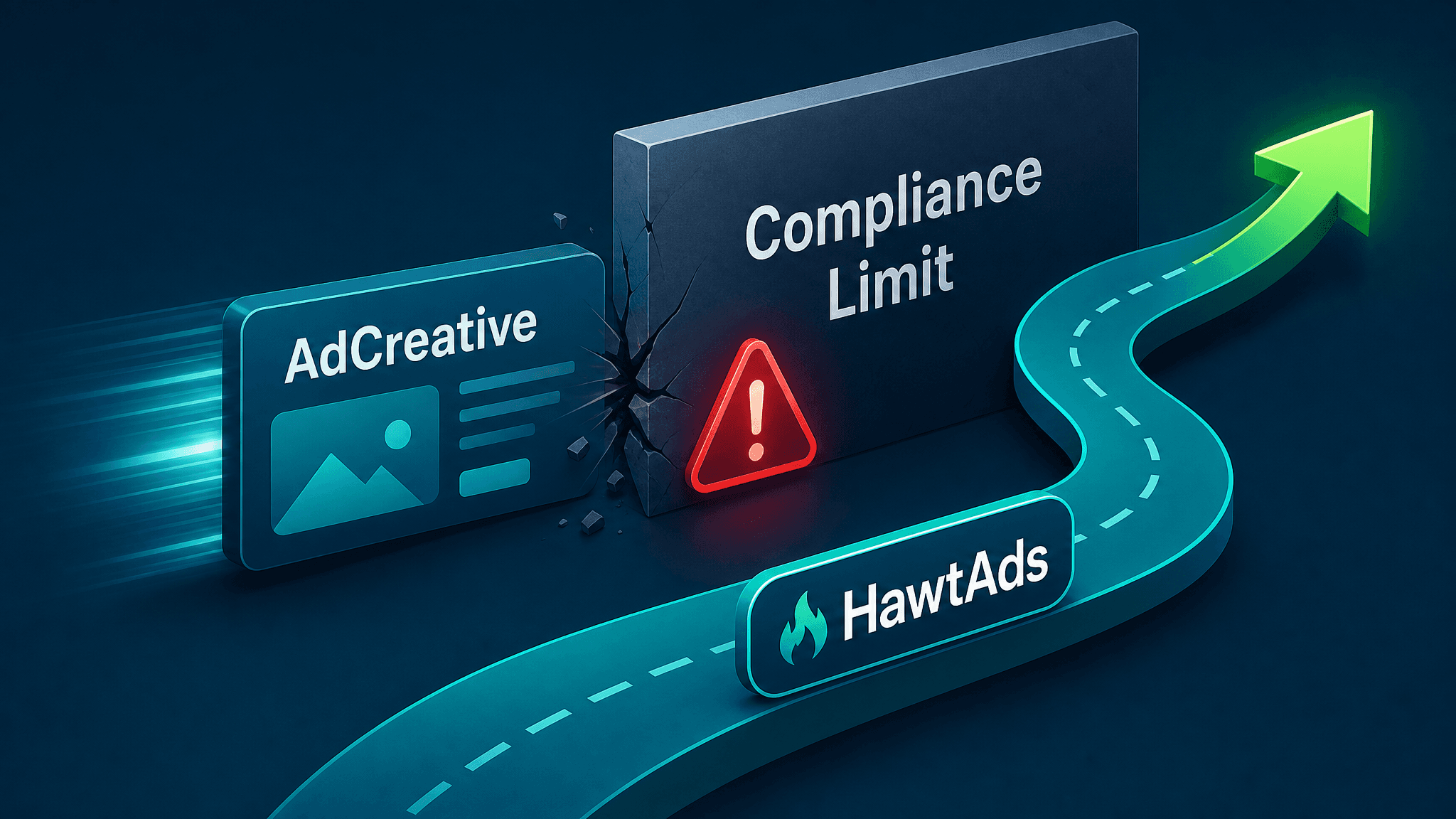
Beautiful design is no longer enough to guarantee ad delivery. In today's highly regulated digital ecosystem, aesthetics must be paired with strict adherence to platform policies. This brings us to a critical conversation for modern marketing teams: when is a pure design tool like Canva no longer enough, and when do you need to introduce a compliance-grade AI ad platform into your stack?
The Undeniable Magic of Canva: What It Excels At
Before we dive into the limitations of traditional design tools in the context of regulated advertising, let’s be absolutely clear: this is not a teardown of Canva. In fact, we love Canva. It is a masterpiece of software engineering that has fundamentally democratized graphic design for millions of businesses around the globe.
For decades, professional graphic design was locked behind the steep learning curves and expensive licenses of complex desktop software. Canva shattered that barrier. It gave marketers, founders, and content creators a cloud-based, collaborative playground where ideas could be brought to life in minutes rather than days.
Canva excels at several critical functions that make it indispensable for modern businesses:
- Rapid Prototyping and Ideation: When you need to get a visual idea out of your head and onto a screen, there is no faster tool. The drag-and-drop interface is intuitive and frictionless.
- Brand Consistency for Organic Content: With features like Brand Kits, teams can ensure that every organic social media post, internal presentation, and email header uses the exact right hex codes and fonts.
- Template Libraries: The sheer volume of high-quality, pre-built templates allows teams with limited design resources to punch above their weight class visually.
- Cross-Team Collaboration: The ability for a copywriter, a designer, and a marketing director to all leave comments and tweak a design in real-time is a massive productivity booster.
If your goal is to create a beautiful Instagram story for your organic followers, design a pitch deck for investors, or create flyers for a local event, Canva is often all you need. But organic social media and internal communications operate under a completely different set of rules than paid digital advertising.
The Turning Point: When "Pretty" Meets "Regulated"
The turning point for most scaling businesses occurs when they shift from relying purely on organic growth to investing heavily in paid acquisition. When you pay Meta, Google, LinkedIn, or TikTok to distribute your content to targeted users, you are no longer just posting on the internet—you are entering a highly monitored, algorithmically policed jurisdiction.
These platforms are under immense pressure from federal regulators (like the FTC, FDA, and SEC in the United States) to prevent fraud, misinformation, discrimination, and harmful claims. To manage the millions of ads submitted daily, these platforms rely on aggressive, automated review systems. These AI bots don't care about your beautiful gradients or your perfect font kerning. They care about one thing: risk.
This risk is magnified exponentially if your business operates in a "regulated" industry. If you are selling t-shirts, your compliance burden is relatively low. But if you are in any of the following sectors, the algorithmic scrutiny is intense:
- Financial Services and Fintech: Crypto, investing apps, personal loans, credit repair, and banking. Promises of specific returns or minimizing financial risk will trigger instant bans.
- Healthcare and Wellness: Telehealth, weight loss supplements, medical devices, and skincare. Claims about curing diseases or unrealistic before-and-after imagery are strictly prohibited.
- HEC (Housing, Employment, Credit): Real estate, job recruiting, and credit card offers. These categories are subject to strict anti-discrimination laws, meaning your targeting and your ad copy must follow rigid guidelines.
- Legal and Professional Services: Personal injury law, immigration services, and tax relief. These ads must avoid predatory language or guaranteed outcomes.
When a designer is working in Canva, the canvas is entirely blank from a compliance perspective. The software allows you to type "Guaranteed 50% ROI in 30 Days!" in a beautiful, bold, 72-point font. It will let you export it in crisp, high-resolution PNG format. But the moment that image hits an ad network's review algorithm, it becomes a liability.
What Canva Can't Do: The Compliance Gap
To understand why a pure design tool falls short for regulated ad campaigns, we need to examine the specific gaps between visual creation and ad platform execution. These are the areas where a compliance-grade AI ad platform becomes essential.
1. Policy Awareness and Real-Time Checking
Ad platform policies are not static. Meta and Google update their advertising standards constantly in response to new legislation, public relations crises, and emerging trends. A rule that applied to cryptocurrency ads six months ago might be completely different today.
Standard design tools have no awareness of these policies. They cannot read the text you place on an image and cross-reference it against the FDA's guidelines for dietary supplements or Meta's prohibited business practices. A compliance-grade AI platform, however, is built on top of these very rules. It uses Natural Language Processing (NLP) and computer vision to "read" your ad creative just like the ad network's review bot will, flagging potential violations before you ever attempt to publish.
2. Spec Automation and Platform-Specific Guardrails
Creating a visually appealing ad is only half the battle; ensuring it actually fits the platform's UI is the other. Have you ever designed a beautiful vertical video for TikTok or Instagram Reels, only to realize that the platform's native buttons (like, comment, share) completely cover your primary Call to Action?
While design tools offer basic templates (e.g., 1080x1920), they don't dynamically enforce "safe zones." Furthermore, some platforms still penalize ads with excessive text-to-image ratios, leading to higher CPMs (Cost Per Mille) and restricted reach. Compliance AI platforms automatically apply these guardrails, ensuring your critical messaging is always visible and perfectly optimized for the specific ad placement.
3. Audit Trails and Approval Workflows
In highly regulated industries, the marketing team isn't the only stakeholder in an ad campaign. The legal and compliance teams must review every single asset before it goes live. If an ad gets flagged by a regulator months down the line, the company needs to be able to prove exactly what was published, when it was published, and who approved it.
Trying to manage this in a standard design tool usually results in a chaotic mess of shared links, Slack messages, and spreadsheet trackers. "Final_Ad_V4_Approved_ActuallyFinal.png" is not a reliable compliance log. Specialized ad platforms provide immutable audit trails, version control, and dedicated approval workflows for legal teams, drastically reducing the friction between marketing speed and legal safety.
Side-by-Side: Pretty but Non-Compliant vs. Compliant and On-Brand
To truly illustrate the difference between a design-first approach and a compliance-first approach, let’s look at a few hypothetical scenarios across different industries. In each case, the first example might look stunning in a design tool, but it will result in rejected ads and wasted time.
Scenario 1: The Health and Wellness Supplement
Imagine a vibrant, beautifully designed ad for a new nootropic brain supplement. The background is a sleek, scientific blue gradient.
- The Canva Approach (Pretty but Non-Compliant): The headline reads in massive, bold text: "Cure Brain Fog and Double Your Focus in Just 3 Days!" The image features a side-by-side "before and after" graphic of a tired brain versus a glowing brain.
The Result: Immediate rejection by Meta and Google. Words like "cure" trigger medical misinformation bots. "Before and after" imagery is strictly regulated and often banned outright in the wellness space. - The Compliance AI Approach (Compliant and On-Brand): The AI flags the word "cure" and the specific timeframe. It suggests an alternative. The new headline reads: "Support Cognitive Clarity and Maintain Daily Focus." The before-and-after image is replaced with a high-quality lifestyle image of a focused professional, retaining the brand's blue gradient.
The Result: Approved instantly. The ad scales smoothly without risking the account, while still appealing to the target audience's desire for focus.
Scenario 2: The Fintech Investment App
A sleek, modern ad targeting novice retail investors, featuring the company's signature neon green brand colors.
- The Canva Approach (Pretty but Non-Compliant): The text reads: "Stop losing money! Use our guaranteed algorithm to make $1,000 this week." It features an image of a soaring green stock chart and a pile of cash.
The Result: Account suspension. Financial platforms cannot promise guaranteed returns, imply that investing is risk-free, or use "get rich quick" imagery like piles of cash. - The Compliance AI Approach (Compliant and On-Brand): The system blocks the words "guaranteed" and specific dollar amounts. It prompts the team to include mandatory financial disclaimers. The revised ad reads: "Discover smart tools to help navigate your investment journey." The soaring chart is replaced with an image of the app's clean UI, and a clear, legible disclaimer is automatically appended to the bottom of the creative.
The Result: The ad passes the platform's strict financial services review process. Legal is happy because the disclaimer is present, and marketing is happy because the ad is live.
Scenario 3: The Real Estate Platform
A warm, inviting ad for a new suburban housing development.
- The Canva Approach (Pretty but Non-Compliant): The copy says: "The perfect starter homes for young, newlywed couples!"
The Result: Rejected for violating HEC (Housing, Employment, Credit) anti-discrimination policies. You cannot imply that housing is restricted to or preferred for specific age groups or marital statuses. - The Compliance AI Approach (Compliant and On-Brand): The AI detects the discriminatory targeting language. It refines the copy to: "Explore beautiful, modern starter homes in our newest community."
The Result: The ad is approved and delivered to a broad, compliant audience.
Enter the Compliance-Grade AI Ad Platform
So, what exactly is a compliance-grade AI ad platform, and how does it fit into the picture? Unlike standard generative AI tools that simply spit out images based on prompts, a compliance-grade platform is engineered from the ground up with ad network policies and legal regulations as its foundational layer.
These platforms act as a sophisticated bridge between your creative vision and the rigid reality of ad networks. They utilize advanced machine learning models that have been trained on thousands of ad policy documents, historical rejection data, and industry-specific regulations.
When you use a platform built for compliance, you are getting a virtual legal reviewer, an ad ops specialist, and a creative optimizer all rolled into one. The AI evaluates the interplay between your images, your on-image text, your headlines, and your primary copy. It looks for red flags—prohibited words, restricted categories, missing disclaimers, and layout violations—and alerts you in real-time. It doesn't just tell you what's wrong; it actively suggests compliant alternatives that preserve your marketing intent.
This technology fundamentally changes the workflow. Instead of the traditional "guess and check" method—where you upload an ad, wait for a rejection, guess what went wrong, tweak the design, and try again—you move to a "predict and deploy" model. You know with a high degree of certainty that your ad will be approved before it ever leaves your server.
Hawtads: The Perfect Complement to Your Design Stack
This brings us to the core philosophy behind Hawtads. We don't believe that marketing teams need to throw away the tools they love. If your team is fast, efficient, and creative in Canva, they should absolutely continue using it to establish your brand identity, create your core assets, and design your organic content.
Hawtads is not here to replace your design stack; it is here to act as the crucial, missing layer between your creative process and your ad deployment. Think of Hawtads as the ultimate "spellcheck" for ad compliance.
Here is what the modern, highly efficient workflow looks like for a regulated brand:
- Design the Core Identity: Your creative team uses their preferred design tools to establish the brand guidelines, color palettes, and base visual assets.
- Import and Generate: You bring those brand elements into Hawtads. Using our AI, you generate dozens of ad variations tailored for specific platforms (Meta, Google, TikTok).
- Automated Compliance Screening: As the ads are generated, the Hawtads engine instantly cross-references the imagery and copy against platform policies and your specific industry regulations. Any risky claims are flagged and rewritten automatically.
- Legal Approval via Audit Trail: The finalized, compliant creatives are routed through a streamlined approval dashboard. Your legal team can review the assets, confident that the AI has already caught the obvious red flags. Every approval is logged for future auditing.
- Deploy and Scale: You launch the ads. Because they have been pre-vetted for compliance, your approval rates skyrocket, your ad accounts stay healthy, and your team can focus on analyzing performance rather than appealing bans.
Don't Let Compliance Kill Your Creativity
The digital advertising landscape is only going to become more regulated. As governments worldwide crack down on digital privacy, consumer protection, and advertising standards, platforms like Meta and Google will continue to tighten their automated review systems.
Relying solely on a design tool to build your paid ad campaigns is like building a beautiful sports car without installing brakes. It looks incredible on the showroom floor, but the moment you take it out on the highway, you are going to crash.
Your marketing team’s time is too valuable to be spent deciphering vague "policy violation" emails or begging ad network support reps to reinstate a banned account. By acknowledging the limitations of pure design software and integrating a compliance-grade AI ad platform into your workflow, you get the best of both worlds.
You get to keep the beautiful, brand-aligned aesthetics that capture attention, while gaining the peace of mind that comes from knowing your ads are safe, compliant, and ready to scale. Let your design tools do what they do best: make things look amazing. Let Hawtads handle the rest, ensuring that your amazing designs actually get seen by your customers.