CBD Advertising on TikTok and Meta: The Complete 2026 Compliance Guide
CBD advertising tiktok meta 2026 requires LegitScript and strict creative vetting. Learn to avoid a 55% rejection rate with our complete compliance guide.
Navigating cbd advertising tiktok meta 2026 requires managing a landscape where Meta's rejection rate for hemp-related ads without LegitScript certification remains above 55%, a hurdle that turns high-potential campaigns into compliance nightmares. For years, hemp marketers have lived in a cycle of manual review hell: spending 48 hours scrubbing "CBD" from every video frame only to have the landing page flagged for a single mention of "wellness." By contrast, performance teams using automated compliance vetting are now deploying campaigns that hit "Active" status in under two hours by aligning creative assets with the specific 2026 algorithmic triggers used by TikTok and Meta.
The gap between a banned account and a scaling brand isn't just the product quality; it is the technical understanding of how automated moderation bots "read" your creative. In 2026, the stakes are higher as AI-driven enforcement has moved beyond keyword matching to visual sentiment analysis and cross-platform landing page crawling.
Meta’s 2026 Policy Landscape: Beyond LegitScript
Meta remains the most viable channel for CBD brands, provided you play by the "LegitScript" rules. As of 2026, Meta’s policy for hemp-derived CBD products in the United States requires advertisers to be certified by LegitScript. This certification isn't a suggestion; it is the gatekeeper for any ad that mentions CBD, even if the product is topical. Without it, your Business Manager is on a countdown to a permanent ban.
The Topical vs. Ingestible Divide
Meta's enforcement bots distinguish sharply between topical and ingestible products. While ingestibles (gummies, oils, tinctures) are technically permitted for certified advertisers, they face 3x more scrutiny from manual reviewers. Topicals (creams, balms, lotions) have a smoother path but still require:
- THC Concentration: Documentation proving the product contains less than 0.3% THC.
- No Medical Claims: Any mention of "treating," "curing," or "healing" chronic pain, anxiety, or insomnia will trigger an immediate rejection.
- Targeting Restrictions: Ads must be targeted to users 18+ (or 21+ in specific jurisdictions) and comply with local laws in every targeted state.
The "Shadow-Flag" Phenomenon
A common frustration for compliance officers is the "shadow-flag." This occurs when your ad is approved, but its reach is throttled because the AI detects high-risk visual elements. In 2026, Meta’s computer vision models are trained to identify hemp leaves, dropper bottles, and even specific shades of "cannabis green" as high-risk indicators. To maintain a high quality score, your creative should focus on the lifestyle benefit—rested faces, active movement, or professional packaging—rather than the plant itself.
TikTok’s Evolving Stance: From Shadowbans to Regulated Reach
TikTok’s relationship with CBD remains more volatile than Meta’s. While the platform has relaxed its stance on topical hemp products in the US and Canada, ingestibles remain a "hard no" in their standard ad manager. If you are marketing CBD gummies on TikTok, you aren't just fighting a policy; you are fighting an algorithm designed to purge your content.
The "Hemp-Derived" Keyword Strategy
On TikTok, the word "CBD" is often a trigger for immediate shadowbanning or ad rejection. Performance marketers have found success by pivoting to "Hemp-derived" or "Plant-based wellness" in their 2026 campaigns. However, the landing page is where most TikTok campaigns fail. TikTok’s crawler is more aggressive than Meta’s; it will scan your entire site for any mention of prohibited substances, even if those products aren't in the ad itself.
Influencer Spark Ads and Compliance
The safest route on TikTok in 2026 is the Spark Ad. By boosting organic content from creators, you benefit from a slightly more lenient review process compared to direct brand ads. However, the creator must follow these rules:
- No "consumption" shots (no one can be seen eating a gummy or applying the oil).
- No medical testimonials.
- No targeting of minors—ensure the creator’s audience demographics align with the 21+ requirement before whitelisting.
The "Safe-List" Creative Framework: Ad Copy Templates
Writing copy for CBD advertising tiktok meta 2026 requires a "benefit-first, ingredient-second" approach. You want to describe the feeling of the product without using the medical terminology that triggers the bots. For more insights on creative strategy, visit our blog.
Template 1: The "Daily Routine" (Best for Meta)
Primary Text: Upgrade your morning ritual with the power of plant-based wellness. Our topical balm is designed for those who refuse to slow down. Experience the difference of premium hemp-derived ingredients. Certified quality you can trust.
Headline: Your Daily Wellness Essential
Why it works: It avoids "CBD" in the primary text (relying on the landing page/LegitScript for the heavy lifting) and focuses on "ritual" and "wellness."
Template 2: The "Problem/Solution" (Best for TikTok Spark Ads)
Video Script Overlay: "How I stay balanced during a 60-hour work week. 🌿 No fluff, just plant-powered recovery for my skin. #WellnessRoutine #HempLife"
Why it works: It uses emojis to soften the text and focuses on "balance" and "recovery," which are softer terms than "anxiety" or "pain."
Template 3: The "Transparency" Post (Best for Retargeting)
Primary Text: Transparency matters. Every batch of our hemp-derived topicals is third-party lab tested for purity and potency. No fillers, just the plant-based support your skin deserves. View our latest lab results on the site.
Headline: Lab-Tested Purity.
Why it works: It builds authority and compliance trust by highlighting "lab testing," a key requirement for 2026 ad approvals.
The 2026 CBD Compliance Checklist
Before you hit "Publish," run your campaign through this checklist. Failing even one of these points can result in a permanent account flag.
- LegitScript Badge: Is your certification current and linked to your Meta Business Manager?
- Landing Page Hygiene: Does your landing page contain any FDA-prohibited medical claims (e.g., "cures insomnia")?
- THC Disclosure: Is the <0.3% THC disclaimer clearly visible in the footer of your landing page?
- Age Gating: Is your campaign targeting strictly 18+ (Meta) or 21+ (TikTok)?
- Visual Check: Have you removed all hemp leaves, smoking imagery, or "stoner culture" aesthetics from the creative?
- Ingredient Transparency: Does the ad link to a page with a clear Certificate of Analysis (COA)?
Managing the "Landing Page Trap"
In 2026, Meta and TikTok use "deep crawlers." If your ad is for a compliant topical cream, but your website's navigation menu links to a "Delta-8" or "THC-O" section, your ad will be rejected. The platforms view your entire domain as a single entity. Many successful brands now use "clean" subdomains or dedicated landing pages that are physically separated from their more "aggressive" product lines to protect their ad accounts.
Automating Compliance to Scale Faster
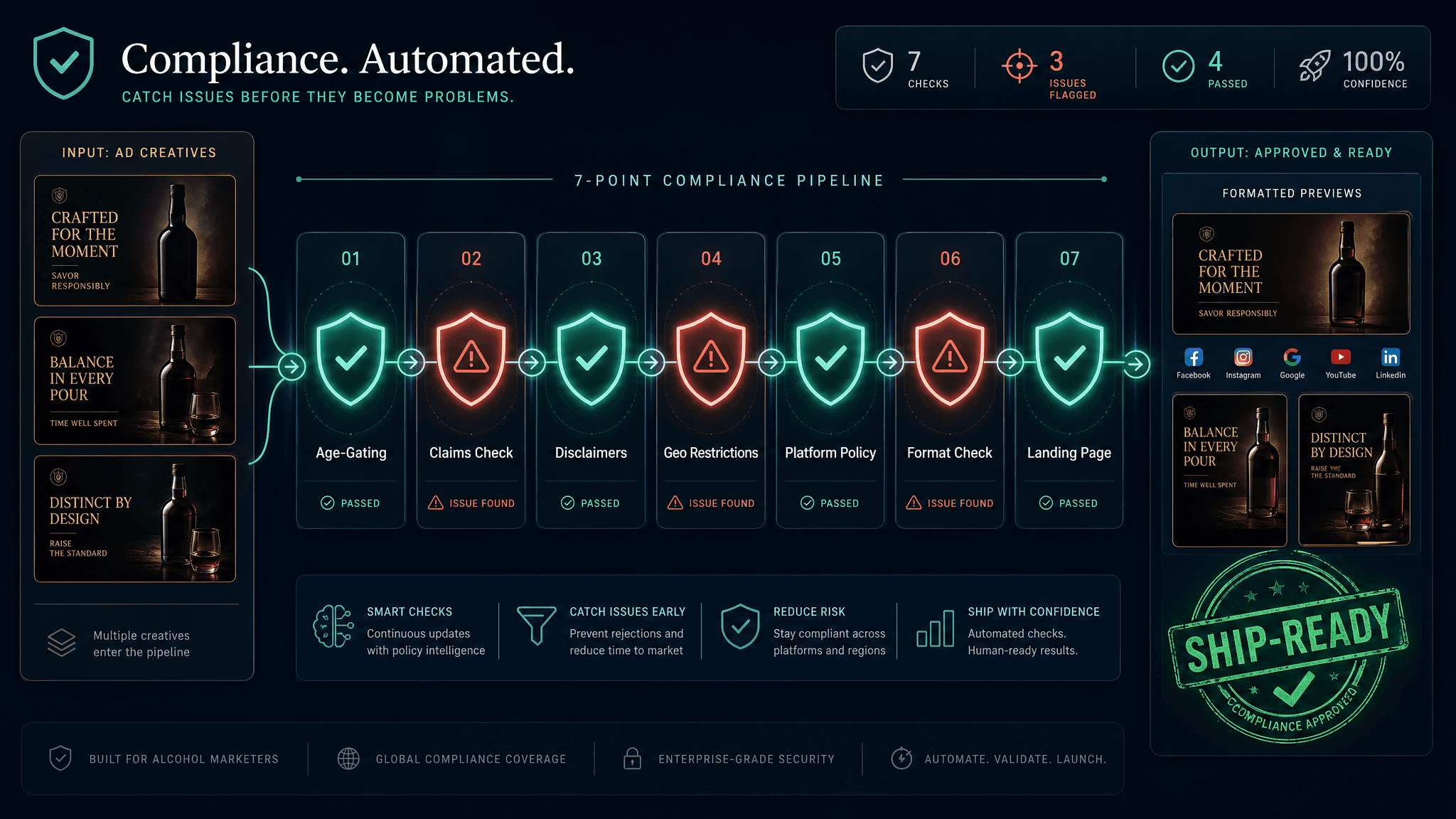
The manual review of every ad frame is the biggest bottleneck in CBD marketing. Compliance officers are often the "department of no," slowing down performance teams who need to test 50+ creative variations a week. By 2026, the industry standard has shifted toward pre-flight AI vetting. This allows marketers to identify "policy-sensitive" frames before they ever reach the platform's moderation queue.
Instead of waiting for a rejection notice to learn that a specific background color or word choice is problematic, brands are using automated tools to simulate platform reviews. This proactive approach is what allows top-tier hemp brands to maintain 95%+ approval rates while their competitors are stuck in the "Account Restricted" loop.
One Takeaway
Success in CBD advertising on TikTok and Meta in 2026 is no longer about "tricking" the algorithm with typos or cloaking; it’s about absolute transparency backed by third-party certification and benefit-driven creative that avoids medical triggers.
Next Step
Audit your current landing pages for "medical claim" triggers like "anxiety relief" or "pain killer" and replace them with compliant alternatives like "calm" or "recovery support" before launching your next campaign. To see how you can automate this entire vetting process, explore the platform today.