The Compliance-First Content Marketing Playbook for Regulated Brands
The Compliance-First Content Marketing Playbook for Regulated BrandsImagine you’ve spent three weeks crafting the perfect campaign. The copy is punchy, the visuals are thumb-stopping, and the strategy is backed by months of data. You hit "send" to the legal department, feeling confident. Then, for…
Legal review should not be the step where good marketing dies. If your campaign comes back covered in red ink after three weeks of work, the process started in the wrong place.
The pattern is common. Three weeks of copy, visuals and strategy. A confident send to legal. Forty-eight hours later the document returns slashed, annotated with "cannot say this," and stripped of everything that made it interesting.
In fintech, healthcare, insurance and gaming that is a normal Tuesday. Marketers in highly regulated sectors spend up to 40% more time in the approval phase than their counterparts in retail or tech. That compliance tax costs speed to market and budget, and it is avoidable.
Compliance does not have to be the finish line you trip over. It can be the track. A compliance-first content marketing approach builds the rules into the brief, which is faster than discovering them in review.
What moving fast actually costs
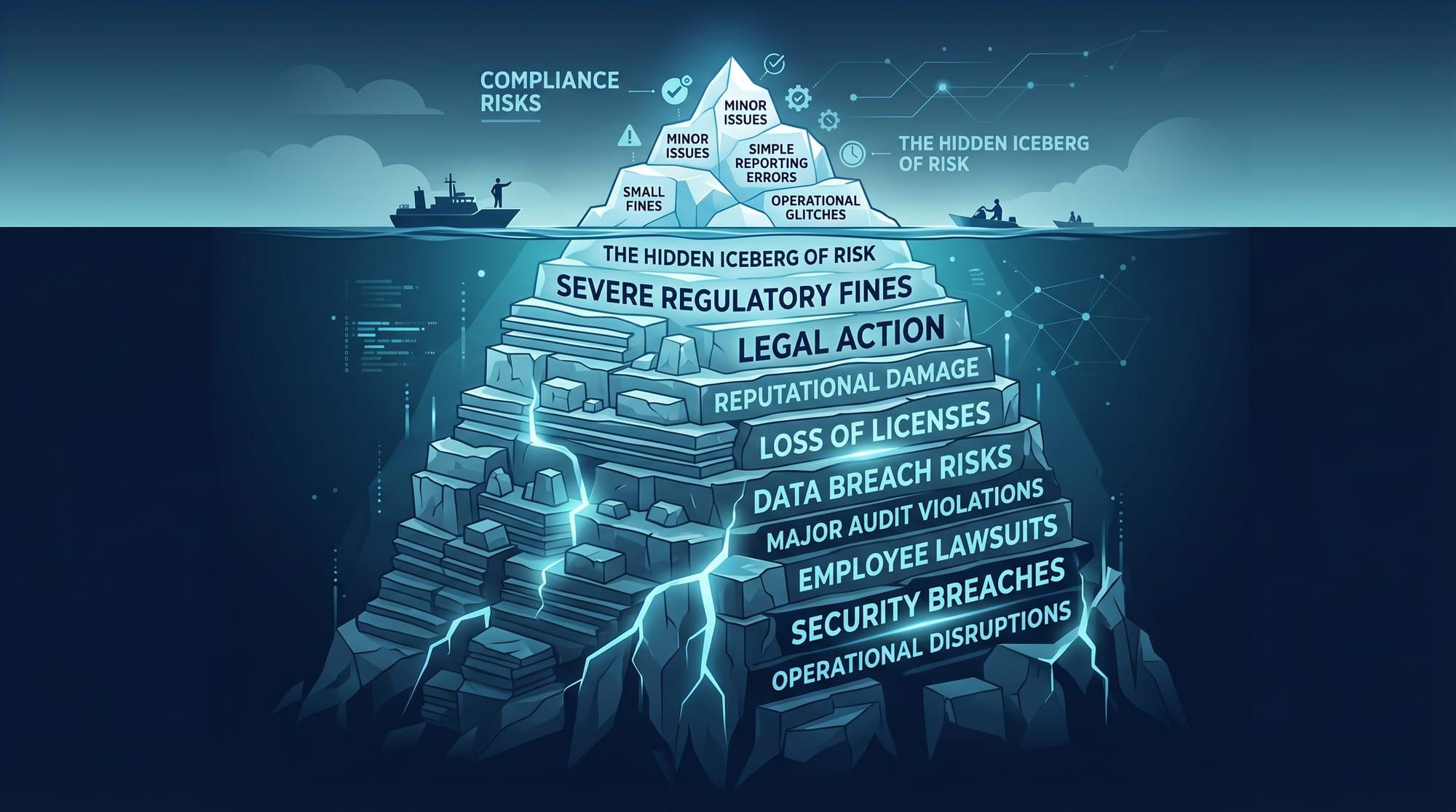
For years the industry mantra was to move fast and break things. In a regulated environment, breaking things invites a government response. An SEC fine for a misleading social post or an FDA warning letter for an unsubstantiated health claim is not a growth strategy.
A non-compliance event costs a financial services firm in three places at once: the fine, the legal fees, and the brand equity that takes years to rebuild. In a category where trust is the product, one slip takes years to repair.
Brands struggle with this because compliance is treated as something that happens to the content rather than something built into it. A regulated brand content strategy that starts with safety produces more creative freedom inside clear boundaries, not less.
What compliance-first means in practice
It means regulatory requirements arrive at the beginning of the creative process. Instead of writing a post and asking legal to bless it, the writer starts with what the SEC, FINRA or FTC permits in that category.
The building analogy holds. You do not design a glass house and then ask the inspector whether it is safe. You read the code first, then decide how much glass you can use.
The practical test is whether your creative and legal teams talk before a campaign starts. If they never do, the red ink is guaranteed and the only question is volume. When both teams work from the same document, the corrections shrink.
Build the strategy on documentation
Documentation is the foundation. Writers, designers and agency partners cannot guess what is safe.
That means a living compliance style guide. It goes past fonts and colors to forbidden phrases and required disclosures, with the exact wording for each market.
Companies with a documented compliance workflow are 3x more likely to launch campaigns on time than those relying on ad-hoc email approvals. A single source of truth also removes the subjective feedback that stalls reviews.
Risk should be tiered by content type. A top-of-funnel post explaining how inflation works carries less risk than a bottom-of-funnel landing page for a specific investment product. Tiering sends legal attention where the exposure is, and lets low-stakes assets move.
The anatomy of a compliant workflow
In practice a content marketing compliance workflow has five steps.
- Pre-brief. Name the regulator (FDA, FTC) and the specific rules that apply to this campaign before anyone writes.
- Modular build. Use pre-approved blocks for disclaimers and product descriptions.
- Automated screening. Run the draft through an AI compliance check before a person sees it.
- Legal review. A qualified reviewer handles nuance and context.
- Audit trail. Every version and every approval is recorded in one system.
The pre-brief is where most of the saving happens. It is one page: the regulator, the rule that governs the claim, the mandatory disclaimer, the approved proof points and the phrases that are off limits for this campaign. A writer who has that page produces copy that clears review in one pass. A writer who does not produces copy that legal rewrites, which is the expensive version of the same work.
If that process is spread across Slack, email and shared documents, it is not a process. Ask who approved a specific ad last quarter and see how long the answer takes.
Placement matters as much as wording. Regulators look at prominence and proximity, meaning the disclosure must be easy to see and close to the claim it qualifies.
On Meta that can mean putting the disclosure in the first two lines of the caption so the "See More" link does not hide it. On TikTok it can mean an on-screen overlay that stays visible for the duration of the claim. The interface decides as much as the regulation does.
68% of consumers believe brands in regulated industries are intentionally confusing with their fine print. Clear disclosures are a trust asset, not a legal chore.
Where the process breaks
Three failures account for most of the rework in regulated content teams.
The first is reviewing at the end. A campaign that reaches legal fully produced can only be approved or rejected, and rejection means starting again. Reviewed at the brief, the same campaign can be adjusted in an hour.
The second is version drift. One approval covers a headline, then someone edits the headline for a placement, then a variant goes out with a different disclosure and the same approval stamp. The record says approved. The ad says something else.
The third is the informal approval. A sign-off in a direct message, a screenshot of a green checkmark, a verbal yes in a meeting. None of them survive a request to show who approved what, and all of them feel like progress at the time.
Where AI fits
Output expectations keep rising while legal headcount does not. Technology is the only way to close that gap.
Modern tools scan images, video and copy for potential violations in milliseconds. HawtAds automates the creative compliance check so an ad meets industry standards before it reaches the platform. It does not replace the legal expert. It takes the mechanical work, the missing disclaimer and the banned word, off their desk.
The checks worth automating are the ones with a right answer. A disclaimer is present or it is not. A prohibited term is in the copy or it is not. The contrast ratio passes or it fails. The logo sits inside the safe zone or it does not. Those are the mechanical failures that most rejections are made of, and they are the ones a person misses at the end of a long day.
AI-assisted compliance reviews run 90% faster than manual review alone. That speed is what lets a legal team spend its hours on the claims that need judgment instead of hunting for fine print.
Influencer marketing is the weak point
Hand your brand voice to a third party and you still own what they say. The FTC has been clear that not knowing what an influencer would say is not a defense.
Nearly 50% of influencers in the healthcare space fail to disclose their partnerships properly. For a regulated brand that is an open liability.
Vetting and training are the controls. Give every partner a must-say list and a never-say list, and monitor their content as it publishes. A live stream can undo a quarter of careful work in ten minutes, so there has to be a response plan before it happens.
Contracts do part of the work. Disclosure language can be written into the partnership agreement, along with a takedown commitment and the requirement that the brand sees the post before it publishes. That does not remove the monitoring burden, and it makes the expectation explicit before anyone records anything.
Dark posts and the volume problem
Performance teams rely on dark posts, the ads that never appear on the brand timeline. They are also the hardest assets to review, because there are so many variants.
Every iteration needs to be compliant, including the one where only the background color changed. A regulator does not care that the violation appeared in a small test cell.
Some financial brands run more than 5,000 unique ad variations a month. Manual review of that volume is not possible. Automated versioning and review is the only way to keep it covered.
Measure more than zero fines
Zero fines is a floor, not a score. Two other measures tell you whether the system works.
The first is time to market. If the creative-to-legal loop takes two weeks, you cannot respond to a trend or a competitor. A working compliance program should shorten production, because clear rules mean fewer revision rounds.
A third measure worth tracking is the review-to-approval ratio, the share of submitted assets that pass without changes. A low ratio is not evidence of a strict reviewer. It is evidence that the brief did not carry the rules, and the fix belongs upstream.
The second is consumer sentiment. Brands that disclose plainly tend to see stronger engagement, because the audience stops looking for the catch. Compliance, done well, reads as integrity.
The tradeoff is real. A compliance-first system costs more before the first campaign, in documentation, in the style guide, and in the review tooling. A team publishing four assets a quarter may never earn that back. A team publishing weekly across several markets will earn it in the first month, because the alternative is the review cycle it is already paying for.
The direction of travel
State privacy law and GDPR have made the old reactive model unsustainable. Waiting for a problem and then fixing it is a strategy for being left behind.
The advantage goes to teams that treat compliance as a competitive asset. A compliant campaign in 48 hours beats a competitor's three weeks. A reputation for plain dealing beats a clever disclaimer.
As the tools improve, the gap between creative and legal narrows. The software that designs the ad will also tell you whether it is lawful, in real time, in the market it will run in. The question for a brand is whether it is building that capability now or waiting for the next red ink.
Five things to do this week
- Audit the workflow. Map how an idea becomes a live ad, and mark every bottleneck.
- Build a safe list. Collect the phrases, disclaimers and imagery the team can use without a fresh review.
- Meet your legal lead. Ask what frustrates them about the creative team, and listen without defending.
- Set a speed KPI. Measure how long an asset takes to clear approval, then aim to cut it by 20%.
- Automate the mechanical part. Put a tool on the repetitive checks so people handle strategy.
The point of all of it
Marketing in a regulated industry does not have to feel like running hurdles in armor. A compliance-first approach produces a faster, more creative and more trusted organization, because the rules stop being a surprise.
The goal is not to remove the rules. It is to know them well enough that they stop costing you weeks.
If the manual review grind is the bottleneck, HawtAds is built to close the gap between high-performance creative and defensible compliance. You should not have to choose between moving fast and staying safe.