TikTok Ad Policy: Why Your Video Got Rejected and the Edit That Clears Each Rule
Why a TikTok video gets rejected, and the edit that clears each creative rule.
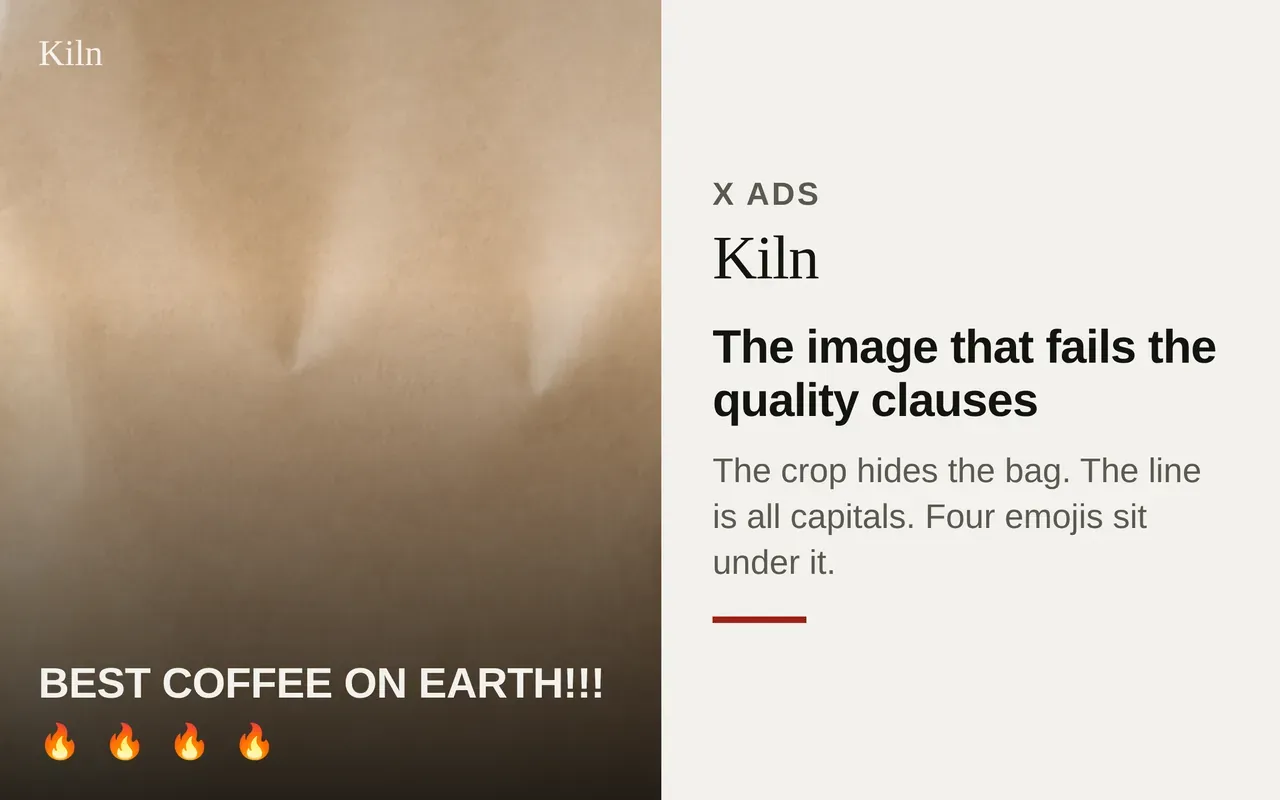
Your TikTok video came back rejected and the notice names no clause. The account still spends and the file in the ad group is what failed. TikTok keeps its video creative rules on a page called Ad format and functionality, filed beside Adult Content and Alcohol, which is not where most buyers look. This piece runs one 15 second nutra video through it and works through the edits that clear each clause it fails.
The short version
- The words drawn into the file can fail it on their own. A play button, or a line telling the viewer to swipe up, promises an interaction the feed does not run.
- A result stated in a fixed time is an absolute term about time, and a before-and-after of the product's effect is named as a comparison TikTok does not allow.
- A held frame counts as a static image. It cannot fill more than half the video.
Checked against TikTok's Ad format and functionality and Misleading and false content pages, both last updated April 2026, and its Weight Management and Body Image page, last updated September 2026, on 23 October 2026. Every rule quoted below comes from those pages, with the link beside it.
The file
Halden sells magnesium capsules. The video is 15 seconds at 9:16 and opens on a bedside table at three in the morning: a glass of water, an amber bottle, a lamp still lit. Two lines of copy sit over the photograph, a play button is drawn into the middle of the frame, and a line under it asks for a swipe. Halden is fictional, and every frame here was composed for this piece.
The rule
The clause sits in the ad and editorial quality section, under a heading covering captions, text, images, audio and video:
Invalid buttons, induced gestures, or text, such as buttons, gestures, or text that portray unsupported functionality. For example: "Swipe up to learn more." text in an ad, because swiping up will just lead users to the next video and not lead them anywhere.
Source: TikTok Advertising Policies, Ad format and functionality.
In plain English: the file cannot tell the viewer to do something the ad does not do. A swipe up advances to the next video, so the line sends the viewer away from your landing page. The same clause covers a drawn play button that starts nothing.
The fix
Out go the play button and the swipe line. What stays is the photograph, the two lines of product copy and the Shop now button, which belongs to the placement and works. That is the whole edit. The clause is clear of the file now. The claim was not.
Preflight reads a still image against the published rules for your placements and returns pass, limited, fail or needs review, with the clause behind each verdict. The cover frame is a still, and a drawn play button is one of the things it flags.
The claim
The second version replaced the swipe line with the claim the buyer wanted to run: "Fall asleep in 4 minutes", with "9 out of 10 sleep better" under it.
TikTok writes:
Ad content and landing pages must not promise or exaggerate results concerning a product's effect. We restrict ads which may mislead our viewers due to false expressions or exaggerated information, and do not allow ad content to feature absolute terms about a product in relation to time, region, or brand.
Source: TikTok Advertising Policies, Misleading and false content.
In plain English: a result in a fixed time is an absolute term about time, and the clause covers the ad and the page it points at. The same page lists comparisons:
Product effect comparisons, such as before-and-after results, which may cause viewers to have a false or distorted impression about a product's outcome/results
Source: TikTok Advertising Policies, Misleading and false content.
Comparisons are not banned outright. The Misleading and false content page allows comparative claims "subjected to the provision of evidence or clear disclaimer(s)", so the disclaimer travels with the claim, in the same frame.
The fix for the claim
The third version drops both numbers and states what is in the bottle: magnesium glycinate, one capsule at night, 30 nights in a bottle. Those are product facts, and the order page repeats them word for word. Nothing promises an outcome, so there is no result to evidence.
The clock
The third finding needs a stopwatch. The 15 second cut held one still on screen for 9 seconds while the voiceover ran, and TikTok treats a held frame as a static image:
Ad content must be dynamic. Do not rely on static or still images as the primary element in your ad. Static images should not occupy more than 50% of the video.
Source: TikTok Advertising Policies, Ad format and functionality.
In plain English: in a 15 second video, 7.5 seconds of stillness is the ceiling, and this cut was over it by a second and a half.
The re-cut holds the opening shot for six seconds, then moves: a hand reaching for the bottle, the lid coming off, the glass filling.
What to run instead
Six directions to brief from.
- Delete every drawn control. No play button, no close box, no swipe arrow. Inside a video, nothing is tappable, and the file should not suggest otherwise.
- Let the placement carry the call to action. TikTok renders its own button under the ad. A drawn one cannot help there and can fail this clause.
- Show the product in use. A hand lifting the bottle, a capsule in a palm, a glass filling. Movement satisfies the static rule.
- Trade the outcome for a product fact. Ingredient, capsule count, bottle size, cost per night. All of it is checkable on your own page.
- Compare the offer, not the body. Bottle size against bottle size, price per night against price per night. Leave the sleep score and the morning face out of it.
- Carry the evidence with the claim. If a comparative claim stays in, the source or the disclaimer sits in the same frame at a size a phone can read.
Other rules that catch a TikTok video
Length and frame size. "The duration of the ad must be a minimum of 5 seconds, and a maximum of 60 seconds." The same section requires a standard shape, which for the feed is vertical 9:16. The three vertical networks are compared in Reels, TikTok and Shorts ad specs compared.
QR codes. "Ad content must not contain quick response (QR) codes." The allowance is narrow: a code printed on packaging inside the shot is acceptable, a code drawn on screen to send viewers to a site is not.
AI-generated content. "Apply the AIGC label, or by adding a clear disclaimer, caption, watermark, or sticker of your own." The page adds: "If we identify AI-generated content that has not been disclosed, your ad will be rejected or restricted." If a creative came out of a model, label it before the upload. The full rules: TikTok's AI labelling rules.
Weight and muscle claims. "Claims that the product alone, without diet or exercise, can lead to weight loss or muscle gain." The page also caps the audience: any weight loss or muscle gain claim has to be restricted to ages 18 and over. Advertisers in adjacent supplement categories hit the same line, which the TikTok and Meta rules for CBD cover.
Before you submit
- Every button, play icon and close box in the file does what it looks like it does, or is gone.
- No line in the file tells the viewer to swipe, tap or shake.
- No result in a fixed time, and no statistic without a source the landing page shows.
- No before-and-after of a body or a body outcome, including a sleep score.
- Count the still seconds, not only the opening shot. Half the runtime is the ceiling.
- Vertical 9:16, 5 to 60 seconds, audio present and clear, text legible at arm's length.
- Caption spelling clean, no symbols between letters. The wording rules are in ad copy that passes Google, Meta and TikTok review.
- An AIGC label on anything a model made.
Frequently asked questions
Why was my TikTok ad rejected with no reason given?
The notice usually names a policy area rather than a clause. Read Ad format and functionality for the file, and Misleading and false content for the words. Start with the frame: drawn text, a held still and a fixed-time claim account for most nutra rejections.
Does a drawn play button really cause a rejection?
TikTok names "Fake video play buttons that do not initiate video playback" in its clickbait section, and the induced gesture clause names a swipe instruction in the ad. A control that does nothing is the case both lines describe. The fix costs one edit and needs no new footage.
Can I use before-and-after photos in a TikTok ad?
Not for a product's effect. The page lists "Product effect comparisons, such as before-and-after results" among what it does not allow, because the comparison distorts the impression of the outcome. Comparative claims are allowed with evidence or a clear disclaimer, so a comparison of offer, size or price is a different question.
How long can a still frame stay on screen?
Half the video. Static images may occupy no more than 50% of the runtime, so a 15 second ad gets 7.5 seconds of stillness and a 30 second ad gets 15. Count every held frame, including a slow push-in on a photograph.
Samples here are fictional. Halden is not a real product, and every frame was composed for this article. Preflight reads still images: video files are outside the check, and TikTok is not one of the five networks it covers, so the cover frame is the part it can help with. Results are advisory, and the network decides. Nothing here is legal advice.