Where Political Creative Can Run in 2026
A practical 2026 channel map for US campaign teams planning creative for Meta, Google, TikTok, video, display, and real-world placements.
A media plan can list Meta, YouTube, connected TV, display, direct publisher buys, and TikTok in six consecutive rows. The creative team may see six places that need video. The platforms see six very different policy environments.
That difference can derail an otherwise organized campaign. A finished ad reaches trafficking and the advertiser has not completed verification. A vertical political video is produced for a paid destination that does not accept political ads. A disclosure that works in one upload path does not satisfy the next one.
The fix starts before production. Confirm where the campaign is eligible to advertise, what the account must complete, which disclosures belong in the file, and which fields belong in the platform. Then build the creative family around the destinations that can actually run it.
Candidate committees, PACs, Super PACs, parties, and advocacy advertisers may enter a platform through different account and sponsor setups. Give each advertiser its own eligibility map. A familiar logo or shared agency does not make one account's approval portable to another.
Build an eligibility map before a format list
The first media-to-creative meeting should produce a one-page channel map. Give each destination an owner and answer five questions:
- Is this advertiser and message eligible?
- Has the account completed the required authorization or verification?
- Which disclaimer must be inside the creative?
- Which disclosure or declaration must be completed during upload?
- Is there a deadline, restriction period, or review lead time that changes production?
This separates three rule sets that are often blended together. Federal and state election rules govern the communication. A platform policy governs whether and how the ad may run there. The media seller or publisher can add its own specifications and acceptance process.
The FEC includes paid communications on another person’s website, digital device, application, or advertising platform in its definition of public communication. Outdoor advertising facilities are also included. Its disclaimer guidance says required notices must be clear and conspicuous. (Federal Election Commission) State and local campaigns need the applicable election rules for their jurisdiction built into the same map.
Save the designer from reconstructing this information across six policy tabs. Put the confirmed destinations, account status, specifications, and upload requirements in the brief. Return files whose names and dimensions point back to that map. The faster political ad review guide shows how to turn those requirements into a usable preflight packet.
Meta allows political ads with an election workflow
Campaigns can run ads about elections, politics, and social issues across eligible Meta placements when they complete Meta’s political advertising process. For the 2026 US midterms, Meta says advertisers in these categories must complete authorization and include a “paid for by” disclaimer. The ads are stored in the public Meta Ad Library for seven years. (Meta’s 2026 US midterm guidance)
That creates a production checklist before the first upload:
- Confirm that the person responsible for the account has completed authorization
- Confirm the exact organization name that will appear in the paid-for disclaimer
- Use the appropriate social issues, elections, or politics setup in Ads Manager
- Keep the creative, landing page, and disclaimer identity aligned
- Record which approved file was connected to the Ad Library entry
Meta also says advertisers must disclose AI use in political, election, or social issue ads in certain cases. When that disclosure is made, Meta adds information to the ad and Ad Library. Meta also says it adds information when it detects content created with third-party AI tools. The upload owner should treat the AI disclosure field as part of trafficking, not as a creative note that can be left behind. (Meta’s 2026 US midterm guidance)
Timing matters in the final week. Meta plans to block new political, electoral, and social issue ads during the final week of the 2026 US election campaign. An ad that recorded at least one impression before the restriction period can continue running. That makes the approval and launch date part of the creative brief. A file finished during the restriction period cannot be assumed to enter the buy. (Meta’s 2026 US midterm guidance)
Plan the family early enough to clear review, receive delivery, and leave room for corrected versions.
Google permits US election ads after verification
Google allows US election ads from verified election advertisers. Its definition covers ads featuring current officeholders or candidates for federal, state, and territory offices, relevant political parties, and qualifying state or territory ballot measures. Advertisers must complete US Election Ads verification before running these ads in the United States. (Google Ads political content policy)
Google limits targeting for election ads to:
- Geographic location, except radius targeting
- Age
- Gender
- Contextual options such as placements, topics, and keywords against sites, apps, pages, and videos
These are the targeting categories Google currently lists for US election ads. (Google Ads political content policy)
Google’s personalized advertising policy separately classifies political content as a sensitive interest category and does not support advertiser-curated audiences for it. The narrower US election-ad targeting list above still controls an election-ad buy. (Google personalized advertising policy) Build the test plan around the options available for the actual campaign and account instead of producing audience-specific concepts that cannot be trafficked as planned.
Verified election ads need a disclosure identifying who paid for the ad. Google automatically generates the disclosure for most formats using verification information. For specified third-party served, Display & Video 360, native, audio, and video paths, the advertiser is responsible for placing the paid-for disclosure directly in the creative. The Google policy lists the affected formats and says a platform disclosure does not replace disclosures required by law. (Google Ads political content policy)
Google also requires election advertisers to declare covered synthetic or digitally altered content in campaign settings. Some feed, Shorts, and in-stream formats receive an in-ad disclosure from Google. For other formats, the advertiser must also provide a prominent disclosure in the ad. Routine resizing, cropping, color correction, and background edits that do not create realistic depictions of actual events are listed as outside the scope of that synthetic-content requirement. (Google Ads political content policy)
Label each Google export by buying path as well as aspect ratio. A 16:9 YouTube upload and a third-party served 16:9 video may have different disclosure responsibilities even when the canvas size matches.
TikTok prohibits paid political advertising
TikTok is not a paid political advertising destination for candidates, campaigns, parties, PACs, or people acting on their behalf. Its current policy prohibits paid political advertising across paid ads, compensated branded political content, Promote, and other monetization features. The prohibition covers promotion or opposition involving current candidates and officeholders, parties, PACs, elections, ballot measures, and policy outcomes. (TikTok Politics, Governments, and Elections policy)
Organic political content is a separate platform activity. TikTok’s paid political advertising policy expressly includes compensated creator content in the prohibition. (TikTok Politics, Governments, and Elections policy)
The narrow advertising exceptions do not create a route for candidate persuasion ads. TikTok says official entities responsible for overseeing elections or referendums may advertise procedural participation information, such as voter registration, voting logistics, participation, and election-related recruitment, after working directly with TikTok and completing certification. Eligible government entities can advertise certain approved public-interest, employment, tourism, cultural, and entertainment messages under the stated conditions. (TikTok Politics, Governments, and Elections policy)
For a candidate campaign, leave paid TikTok political ads out of the asset plan. A team may still need vertical creative for eligible Meta or Google placements. Name those files for their real destinations. Every 9:16 export does not need to inherit the name “TikTok ad.”
CTV, display, publishers, and real-world media need seller-level confirmation
Connected TV, programmatic display, local news sites, streaming audio, outdoor screens, direct mail, and broadcast can all play a role in a US campaign. They do not share one universal upload and acceptance policy.
The buying team should confirm the media seller, demand-side platform, publisher, or station requirements for each order. Ask for accepted codecs, durations, dimensions, file sizes, audio levels, companion assets, disclaimer treatment, review lead time, and any political account paperwork. For broadcast, cable, and satellite ads, the FEC’s guidance includes additional federal “stand by your ad” requirements for covered candidate communications. Internet video has its own disclaimer rules, including a four-second display requirement when the disclaimer appears within the video. (Federal Election Commission)
A destination map might look like this:
| Destination | 2026 planning status | Creative action |
|---|---|---|
| Meta political ads | Allowed for authorized advertisers under Meta’s process | Build placement family, paid-for identity, and upload disclosure checklist |
| Google US election ads | Allowed after US Election Ads verification | Match targeting plan, disclosure responsibility, and synthetic-content fields to buying path |
| TikTok paid political ads | Prohibited outside narrow official-entity exceptions | Do not produce or traffic candidate paid political ads |
| CTV and programmatic video | Seller and platform specific | Confirm acceptance policy, specs, disclosure, and lead time before production |
| Direct publisher placements | Publisher specific | Build to the insertion order and publisher review process |
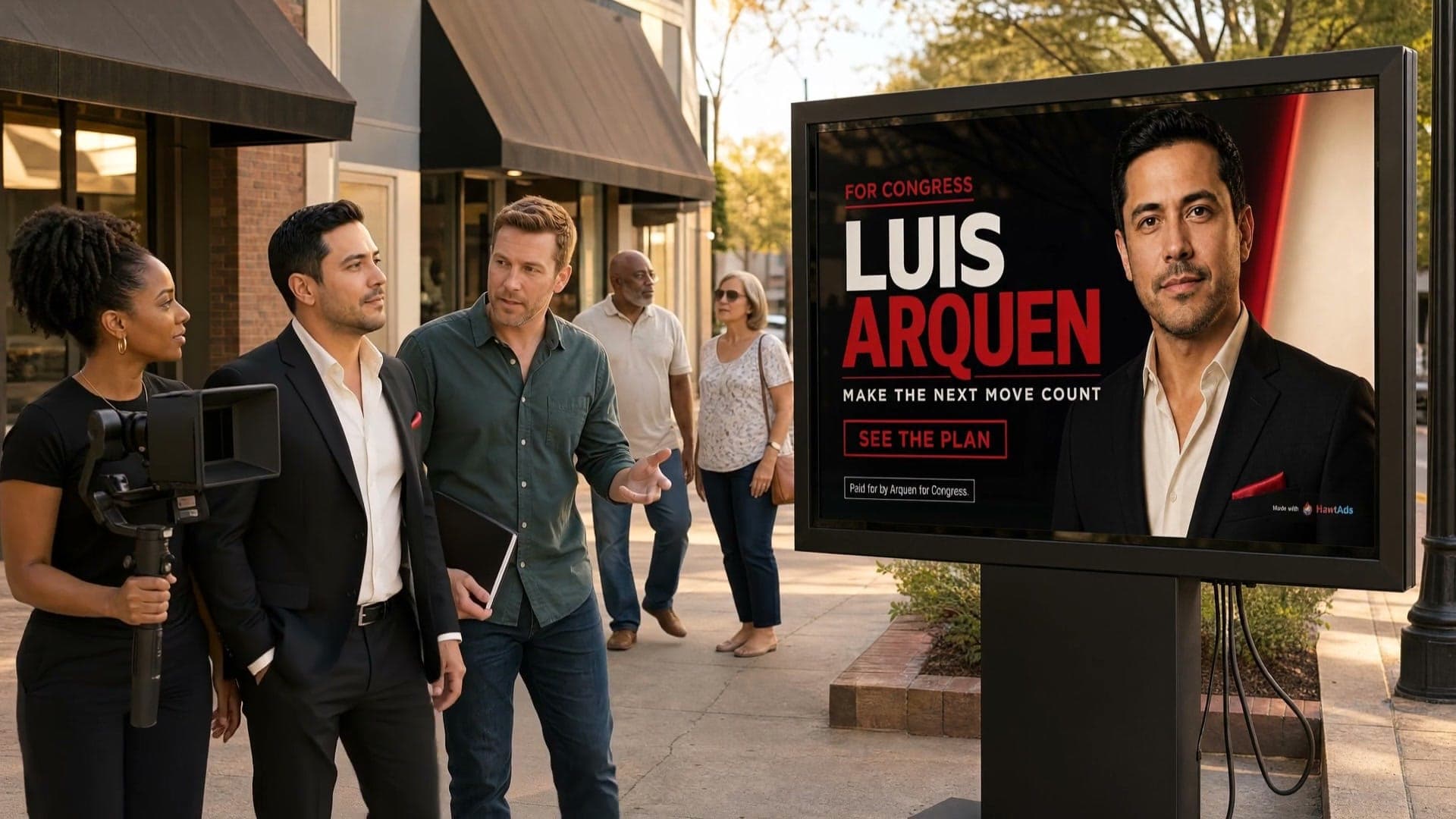
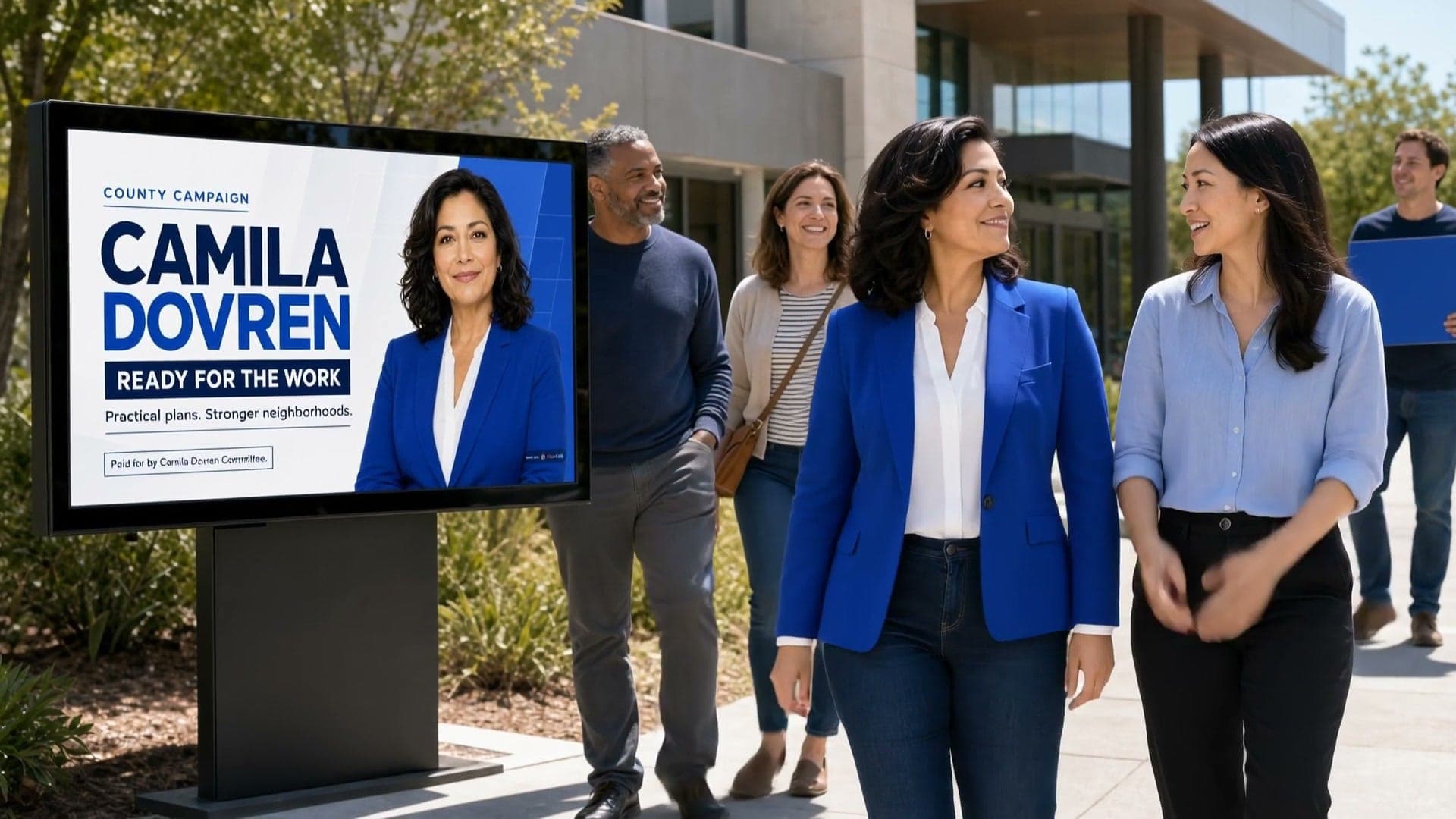
| Outdoor and printed media | Available subject to applicable law and seller requirements | Design disclaimer for viewing distance, format, and placement |
Review that map whenever the buy changes. A new channel can bring another authorization process, disclosure treatment, or final-file specification along with it.
For outdoor and public-screen placements, the HawtAds Ads Engine gives the creative team a focused path from placement context and approved direction to screen-ready artwork.
Make one campaign family with destination-specific finishes
Once eligibility is settled, the creative team can work from one approved campaign system. Lock the candidate identity, core message, proof, payor information, and brand rules. Then make intentional versions for each destination.
HawtAds keeps the production work together: brief the direction, run readiness checks, adapt the idea into the required formats, review the outputs, and ship with the copy, crop, and review trail attached. A square Meta ad, vertical video, landscape pre-roll cut, and display unit can stay related without pretending that their destination requirements are identical.
In a political media plan, the HawtAds Advantage is simple. Each file has a destination, each destination has an owner, and the campaign can scale with confidence without creating more confusion.
Once the channel map is real, put it beside the approved brief in HawtAds and build only for the placements in the media plan. The Political Campaigns workflow gives campaign managers a practical starting point, while the earlier creative testing plan helps decide which eligible variations deserve production.
Frequently asked questions
Can US candidates run paid political ads on TikTok in 2026?
No. TikTok prohibits paid political advertising by candidates, campaigns, parties, PACs, and people acting on their behalf. Its narrow election-related exception is for official entities that oversee elections or referendums and complete TikTok’s required process.
Does Google allow US election advertising?
Yes, for advertisers that complete Google’s US Election Ads verification and follow its targeting and disclosure requirements. The exact paid-for and synthetic-content steps depend in part on the format and buying path.
What should a campaign finish before producing channel adaptations?
Confirm advertiser eligibility, account verification, the exact payor identity, applicable disclosure language, upload declarations, specifications, and review deadlines. Then adapt one approved campaign direction for each eligible destination.