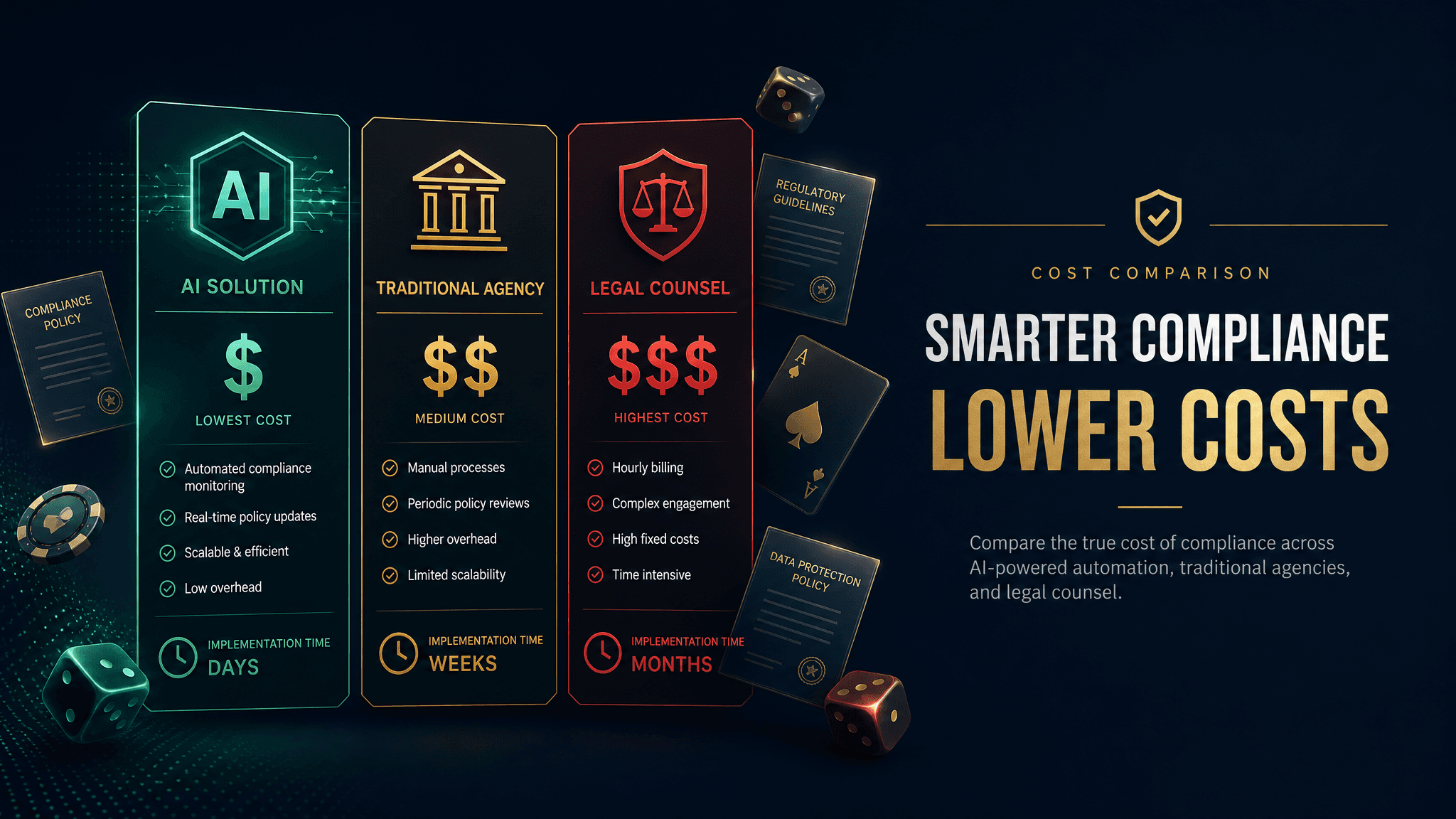
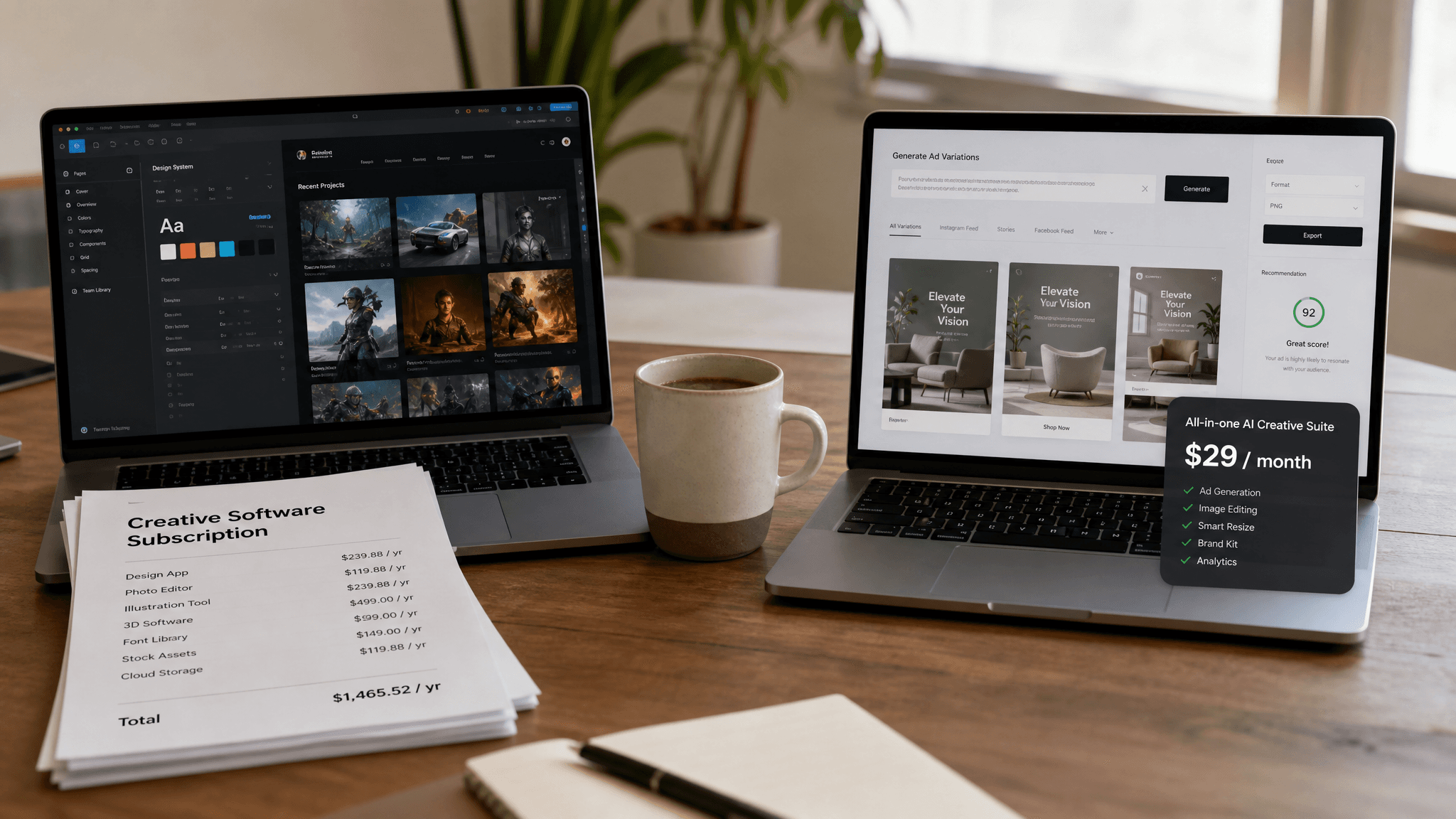
Your Compliance Lawyer Costs $400/hr. Here's What an AI Pre-Check Costs.
Your compliance lawyer bills $400/hour. Minimum one-hour increments. A single ad review usually takes 45-90 minutes when you factor in the back-and-forth emails, the PDF markups, and the final sign-off. That's $400–$800 per ad. If…
Your compliance lawyer bills $400/hour. Minimum one-hour increments.
A single ad review usually takes 45-90 minutes when you factor in the back-and-forth emails, the PDF markups, and the final sign-off. That's $400–$800 per ad. If you’re running a performance setup in a regulated space—think fintech, healthcare, or alcohol—you aren't just launching one ad. You’re launching 20 variations of a hero concept. Do the math: that’s $8,000 in legal fees before a single dollar of media spend has even left your account.
An AI compliance pre-check costs $0.17 per ad. It takes less than 60 seconds. It doesn't bill in increments, and it doesn't take lunch breaks.
This isn't about firing your legal team. It’s about stopping the bleeding. Here is the line-by-line breakdown of what you’re paying now versus what you should be paying, so you can take the business case to your CFO tomorrow morning.
Section 1: The Current Cost Stack (What You’re Paying Now)
Most performance marketers treat compliance as a "black box" cost. It’s just something you pay to stay out of jail or off the regulator’s radar. But when you audit the actual workflow, the "Ad Legal Review Cost" is significantly higher than just the invoice from the firm.
1. External Legal Review: $400–$800/hr
If you’re in a high-stakes vertical, you’re likely using an outside firm. They bill for every minute. Even a "quick look" at a batch of 10 ads usually results in a $2,000+ invoice. At a weekly cadence, that’s $8,000–$10,000 a month just for the stamp of approval.
2. Internal Compliance Team Time
Your internal compliance officer isn't cheap either. If they’re making $120k/year, their time is worth roughly $60/hr. If they spend 15 hours a week reviewing creative variations for minor policy infractions—like font size on a T&C disclaimer or the presence of a specific disclosure—you’re burning $3,600/month in internal overhead.
3. The Delay Cost: The Silent Killer
Every day an ad sits in a lawyer's inbox is a day it isn't generating revenue. In performance marketing, momentum is everything. If your legal review cycle takes 3 business days, and you launch 4 batches a month, you’ve lost 12 days of optimization time. We’ve previously covered how regulated brands lose $47k monthly simply due to these delays and the resulting account friction.
4. Rework and Rejection Costs
When a lawyer catches an issue, the creative goes back to the design team. That’s more billable hours for designers and more project management overhead. If the review misses an issue and the ad gets flagged by Meta or Google, the cost skyrockets. You risk shadow-banning, increased CPAs, or total account suspension.
Total estimated monthly compliance cost for a mid-size regulated advertiser: $12,000–$25,000
Section 2: The AI Pre-Check Cost Stack
The shift to AI-powered compliance isn't just about speed; it's about shifting the unit economics of creative production. When the cost of a check drops to the price of a postage stamp, your entire strategy changes.
- Per-ad cost: $0.17 (based on Hawtads Pro plan credits).
- Speed: Under 60 seconds per ad. You can check a batch of 50 variations in the time it takes to pour a coffee.
- Coverage: 7+ automated policy checks per ad. The AI looks for specific regulatory triggers, platform-specific prohibited content, and brand-safety requirements simultaneously.
- Volume: Unlimited scalability. Whether you’re running 5 ads or 5,000, the incremental human cost is zero.
For the same mid-size advertiser mentioned above, running 500 creative variations a month through an AI pre-check would cost roughly $85. Even with a premium platform subscription, the total monthly spend sits between $150 and $500.
Total estimated monthly: $150–$500 (vs. $12,000–$25,000)
Section 3: The Hybrid Model (The Strategy That Actually Works)
Let’s be direct: AI is not a replacement for a qualified legal mind. If you are navigating a complex new ruling from the CFPB or the FDA, you need a human who understands nuance. However, you do not need that human to check if your "Terms and Conditions apply" text is 10-point font or if your crypto ad contains a prohibited "guaranteed return" phrase.
The most efficient brands use a Hybrid Model:
- AI Pre-Check: Catches 80%+ of "objective" policy violations (missing disclaimers, prohibited keywords, visual non-compliance).
- Creative Rework: Designers fix the obvious flags immediately, before any lawyer sees them.
- Human Review: The lawyer only reviews the final, "clean" versions or the 20% of ads that require a subjective judgment call.
Your lawyer doesn't lose their job; they just stop reviewing font sizes and start reviewing strategy. One DTC alcohol brand we worked with was spending $18,000/month on external legal review. By implementing an AI pre-check to "clean" the ads first, they reduced their legal bill to $4,000/month while actually increasing their ad output. You can read more about this in our guide to compliance scoring and pre-submission ratings.
Section 4: The ROI Calculation (Use This in Your Budget Meeting)
When you sit down with your CFO or Head of Growth, don't talk about "AI features." Talk about "Operating Margin." Use these figures to build your case for an automated ad compliance tool:
The "CFO Ready" Math
- Current Annual Compliance Spend: (Legal Fees + Internal Hours + Rejection Losses) x 12. For many, this is $150,000–$300,000.
- Proposed AI-Hybrid Spend: (Platform Subscription + Reduced Legal Fees). Typically $40,000–$60,000.
- Net Annual Savings: $110,000–$240,000.
- Payback Period: Typically within the first 30 days of implementation.
Beyond the direct savings, there is the Velocity Gain. If you can launch ads 4 days faster because you aren't waiting on a legal queue, how much more revenue does that generate over a fiscal year? For an enterprise spending $500k/month on media, a 10% increase in agility can easily result in $500k+ in additional annual revenue.
FAQ: Addressing the "Buts"
"Is this replacing my lawyer?"
No. It’s a filter. It ensures your lawyer’s $400/hr time is spent on high-level risk assessment, not proofreading. It's the difference between a spell-checker and an editor.
"What about liability?"
AI provides a first-pass risk score. You still maintain your internal "Source of Truth" for final approval, but the AI provides a documented audit trail of every check performed, which is actually better for compliance records than a scattered chain of emails.
"Does the AI stay current with policy changes?"
Hawtads updates its models as platform policies and regulatory guidelines evolve. Unlike a human who might miss a Friday afternoon update from Meta, the AI's "rulebook" is updated globally and instantly.
Stop Paying "Lawyer Rates" for "Software Tasks"
Every time you send a basic creative variation to a legal firm for a "sanity check," you are effectively burning cash. In a market where CAC is rising and margins are thinning, you cannot afford to maintain an antiquated, manual review process.
The math is undeniable. $400/hr vs $0.17/ad. It’s time to stop overpaying for compliance and start investing in performance.
P.S. The $0.17/ad number is real—it’s based on our standard credit pricing. The $400/hr lawyer number is actually conservative; we’ve seen specialized firms in the pharma and fintech space bill at $800+/hr. If you're paying that to have someone look at a JPEG, we should talk.