Platform Bans Without Warning: How to Protect Your Ad Accounts in Regulated Industries
You wake up, grab your coffee, and open your laptop to check the overnight numbers. Instead of a dashboard full of green upward trends, you’re met with a chilling red banner: "Your advertising account has been disabled for violati…
A platform ban arrives without a warning, a specific reason, or an appeal path you can plan around. For a business in a regulated category, the ad account is the distribution channel, and losing it is a revenue event rather than an inconvenience.
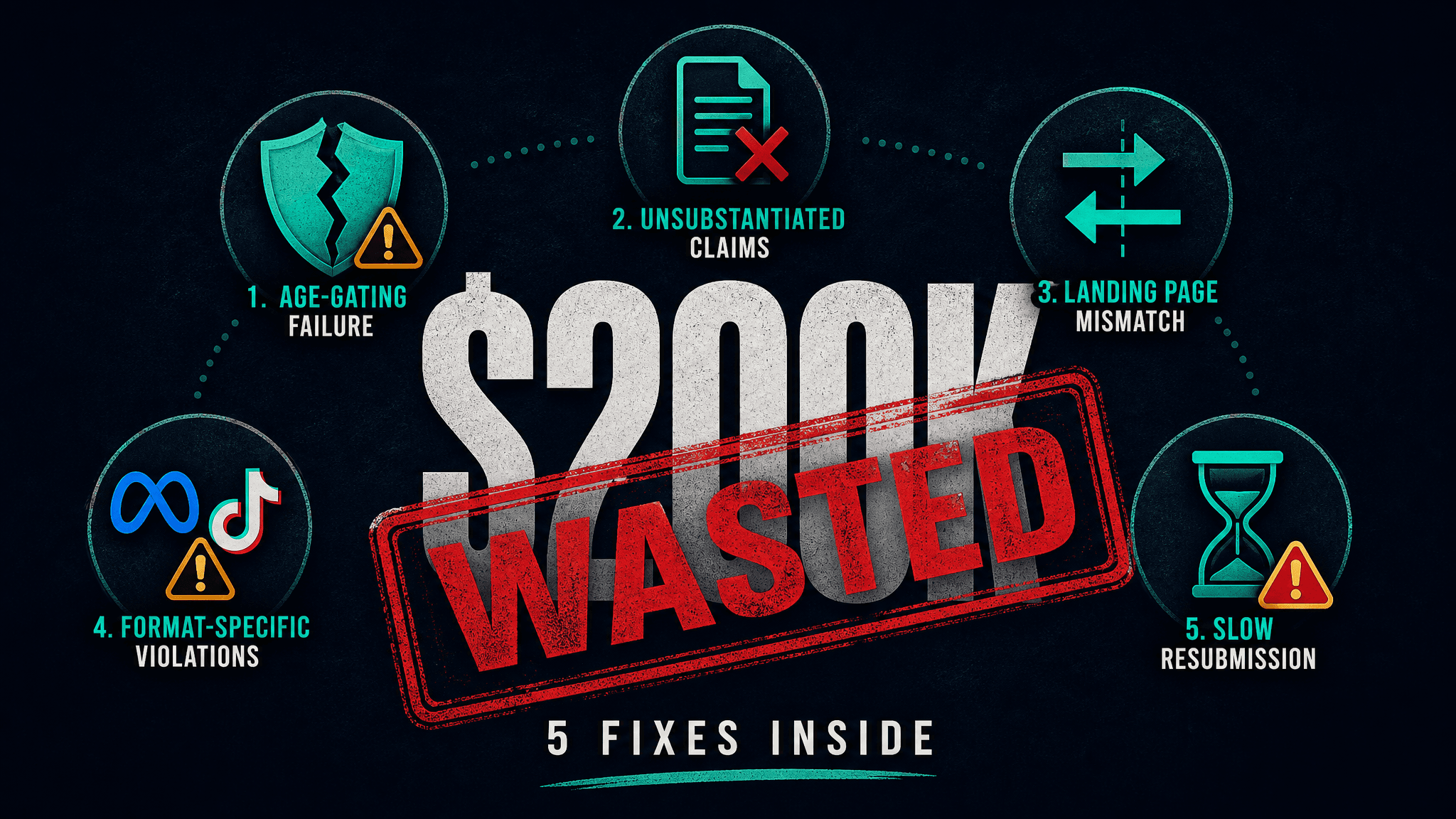
Meta alone disables over 1 billion fake or non-compliant accounts every year. Most are bots. Thousands of legitimate businesses in regulated sectors get caught in the same automated moderation, and the process that catches them was designed to err toward removal.
The work of protecting an account is mostly preventative. It happens in the creative brief, the landing page, the billing record, and the account structure, long before a red banner appears.
Regulated accounts carry a higher risk score
Google, Meta, and TikTok are under pressure from regulators to prevent misinformation and predatory advertising. When an account operates in a regulated space, its risk score is higher, and the algorithms are tuned to act rather than wait.
Platforms would rather ban a compliant account by mistake than let one non-compliant ad through and absorb the regulatory cost. That is the tradeoff they have chosen, and it explains why a clean account can still be disabled.
Google's enforcement runs at a scale no individual advertiser can influence, and healthcare and medicines violations are one of the categories it counts. The volume is the point: enforcement is statistical, and an individual account is a data point inside it.
What a suspension costs
A ban stops the pixel learning, cools the retargeting audiences, and pushes customer acquisition costs up by 30% to 50% once the account returns. The account may return with less history than it had.
A 48-hour shutdown on a mid-market account can mean tens of thousands of dollars in lost revenue. That number belongs in the risk plan next to the media budget, not in the postmortem after the first ban.
Most bans start with one creative
Account-level enforcement usually begins with a single asset. In regulated categories the visual cues matter as much as the words, because the scanners are trained on both.
In weight loss and supplements, before-and-after photos are a guaranteed rejection. A zoomed-in shot of a body part, such as a stomach or a knee, can trigger a sensationalist content flag because the system reads it as an idealized body type or an unrealistic expectation.
Audit creative assets for three patterns:
- Absolute claims: guaranteed, cure, and 100% results are instant flags.
- Negative self-perception: ads that imply the viewer has a problem they must fix, such as "Are you tired of being broke?", often violate personal health or personal attributes policies.
- Misleading interface elements: visual elements that look like play buttons or checkboxes but do not function are treated as circumventing systems.
In the financial sector, a large share of rejections trace back to unclear terms and conditions inside the creative itself. Disclosures that are legible on a desktop mockup can disappear on a phone.
The landing page is part of the ad
A compliant ad that lands on a questionable page still puts the account at risk. Platform crawlers follow the funnel and compare what the ad promised with what the page delivers.
Common triggers include exit pops that trap the user, countdown timers that reset on refresh, and missing About Us or Privacy Policy links. A page that feels like a trap gets the account flagged for compliance issues.
The test is simple: does the page state a clear value proposition without high-pressure tactics? A page that states its terms plainly is the difference between a queue and a launch.
Why appeals are a poor plan
Many advertisers assume an appeal will reach a human who will see the account is right. Manual review can overturn a ban, and it also puts the entire business history under a microscope.
A human reviewer looks at the flagged ad, the billing history, the connected pages, and the personal profile behind the account. A pattern of minor infractions can produce a permanent ban that an automated system would have reversed.
In 2021, TikTok reported that only about 10% of automated bans were successfully overturned on appeal. The goal is not to win the appeal. The goal is to never need one.
Build a trust profile
Trust accumulates through boring behavior:
- Consistent billing: use a reputable business credit card. Failed payments signal a burner account.
- Gradual scaling: moving from $100 a day to $10,000 a day overnight triggers unusual activity alerts.
- Engagement: respond to comments on your ads. High hidden-ad rates and report-ad clicks damage account health.
Do not run the business on one account
A business that depends on a single Meta ad account is running a gamble. Even with perfect compliance, algorithms glitch and mistakes happen.
A multi-account structure is not a churn-and-burn operation. It is a primary agency Business Manager, several verified sub-accounts, and a clear separation of assets. If one account is flagged for a creative misunderstanding, the operation keeps running.
A brand spread across three or more platforms keeps running when one of them sweeps its category. Diversification is the cheapest insurance in the plan.
What AI checks can and cannot do
If the platforms use AI to enforce policy, the same technology can be used before submission. The pace of regulatory change is faster than any human team can track manually, between GDPR, state privacy laws, and platform community standards that change without notice.
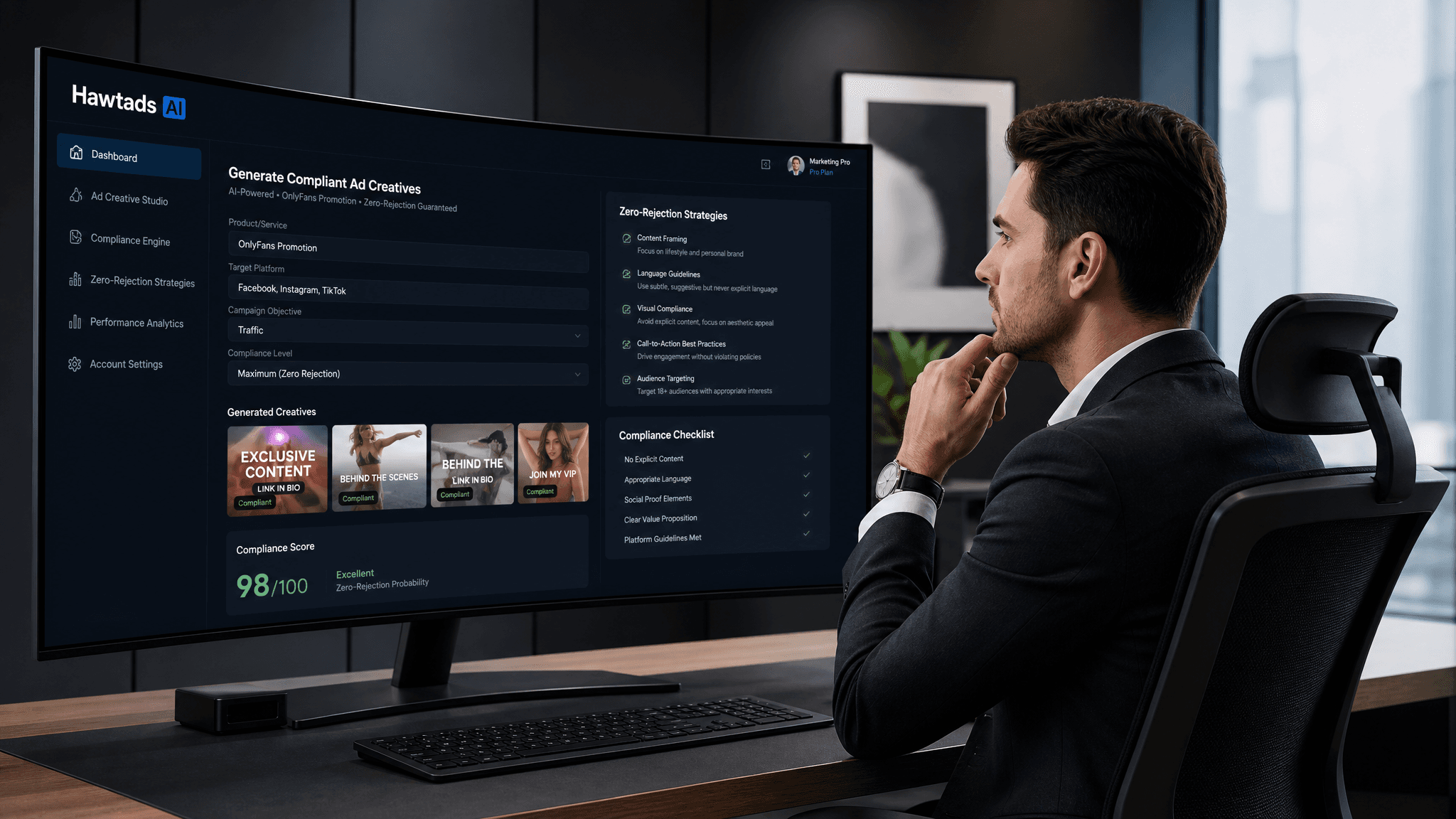
AI-powered compliance tools scan copy and imagery before the ad is submitted and flag the triggers that lead to a ban, including the proportion of skin in an image or the sentiment of a headline. Teams using pre-submission checks catch the triggers before the platform does.
The limit is judgment. A tool can tell you that a claim is risky. It cannot tell you whether the claim is true, whether the disclosure satisfies a specific regulator, or whether the offer is one the business should make. That decision stays with the team.
Monitoring after launch
The most dangerous time for an account is while the team is asleep. If a high-performing ad starts collecting negative reports or crosses a new policy threshold, it needs to pause before the account absorbs the strike.
Automated monitoring can pause ads at a set risk threshold. The tradeoff is that a false positive costs delivery, so the threshold should be tuned on a small budget before it runs across the account.
A checklist for the quarter
Protecting an account is a process, not a setting.
- Audit the assets: review every active ad for absolute claims and sensationalist imagery.
- Check the funnel: confirm the landing pages carry the required disclosures and no hostile UX patterns.
- Verify the business: complete Business Verification on every platform. It raises the trust score.
- Diversify the spend: no single account should carry all of the lead flow.
- Automate the checks: catch the errors before the platform does.
The margin for error in a regulated category is close to zero, and the rules get stricter every year. A team that waits to see what happens is betting the primary revenue channel on the platform's patience.
Compliance as a process
Account protection should not be a full-time job that competes with growth. The goal is a system where the checks run inside the creative workflow, so the team can ship without watching for a red banner.
HawtAds is a general ad creation tool with additional features for regulated verticals. It builds the creative set and runs readiness checks on claims, crops, and disclaimers before submission, which is the part of account protection that a creative team can control.
It does not replace business verification, platform relationships, or a diversified media plan. It removes the avoidable rejections that come from a claim or a crop that nobody checked.
Start with one account and one quarter of rejections. Review what caused them, fix the template, and measure whether the next quarter is quieter.
Ready to stop worrying about platform bans and start scaling with peace of mind? Discover how HawtAds can safeguard your ad accounts today.