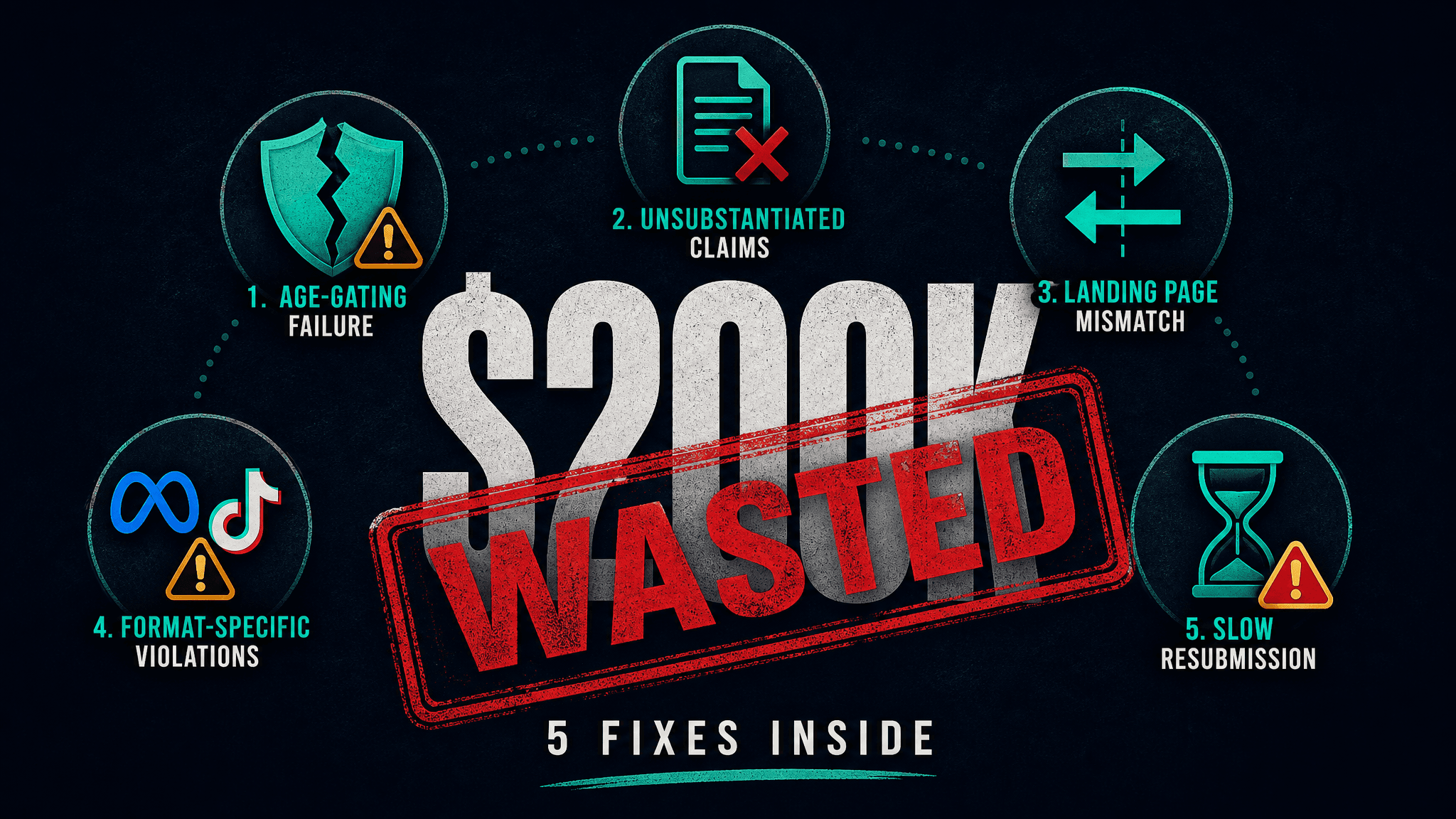
The 3 AM Scramble: When Your Campaign Launch Gets Blocked by Compliance
The 3 AM Scramble: When Your Campaign Launch Gets Blocked by ComplianceThe coffee is cold, the office is silent, and your eyes are stinging from the blue light of your dual-monitor setup. It’s 3:00 AM. You’ve spent the last six weeks perfecting a global campaign for a new fintech product. The creat
The most expensive time to learn that an ad breaks platform policy is 3 a.m. on launch day. By then the creative is produced, the budget is committed and the media team is awake. The block is not the problem. The timing is.
The scene is familiar to anyone in a regulated category. Six weeks of work on a global fintech campaign. Targeting built, budget approved, creative signed off. You press publish and get a brick wall: an ad campaign compliance block. Then come the emails to legal, the refreshed ad manager screens, and the search for the one word or pixel that triggered it.
In finance, healthcare and iGaming, that is not a nightmare. It is a Tuesday. The gap between a creative vision and a live ad is guarded by platform policy and legal requirements, and when the two collide at the last minute the cost is real.
Plenty of delayed campaign launches in regulated sectors trace back to campaign launch compliance issues that nobody caught during the creative phase.
What a last-minute rejection actually costs
Most marketers count the inconvenience. The bill is larger than a lost night.
Every hour an ad sits in rejected status is an hour of lost data, lost share and idle overhead. In a competitive window, such as a product launch or a seasonal event, being offline for 12 hours can raise eventual customer acquisition cost by 15-20%, because the initial momentum is gone.
Then there is the internal cost. When regulated ad launch problems recur, marketing and compliance stop cooperating. Marketing treats compliance as the department of no. Compliance treats marketing as reckless. Every later project inherits that friction.
When marketing and compliance stop cooperating, every later project inherits the friction: the same review takes longer, and the launch calendar absorbs the difference.
Manual review does not scale to the volume
The standard process has been linear: marketing creates, legal reviews, the platform decides. A brand running 5,000 ad variations across ten jurisdictions breaks that process. People are good at nuance and bad at catching a missing terms link in the 499th banner.
That is the arithmetic worth doing. 5,000 variations across ten jurisdictions is a queue, not a list, and the queue grows faster than a review team can clear it. Attention runs out. The manual model fails on calendar rather than on diligence.
The platforms make it harder. Meta, Google, TikTok and LinkedIn each maintain their own advertising policies, and those policies change without a formal announcement. What passed on Tuesday can fail on Thursday.
Manual review also has a measurable error rate. The misses are concentrated in small details: font size for disclaimers, a prohibited keyword in one region, a required icon in the wrong corner.
The question is not whether legal should review the work. It is whether your most expensive legal talent should spend the week squinting at font sizes on mobile mockups.
Why compliant ads still get flagged
The most frustrating version of campaign launch compliance issues is the false positive. The rules were followed, legal signed off, and the automated system still rejects the ad. The tools built to keep platforms safe are blunt, and a legitimate regulated ad looks unusual to them.
Meta and Google scan billions of ads with machine learning models trained to be risk averse. If an ad resembles a violation, through a combination of colors, a trigger word used in a benign context, or a landing page that loads half a second too slowly, the system defaults to reject.
After that comes the appeal queue. Your appeal may be read by another model, or it may wait 48 hours for a person. An appeal can be overturned, but it can also sit in a queue for days, and by the time it clears the campaign has lost its momentum. The revenue lost while an ad sits in review is the part nobody budgets for.
Move the check to the creative stage
Software teams call it shifting left: run the quality checks as early as possible instead of at the end. Regulated advertisers need the same move.
Most compliance checks today happen at the end of the creative lifecycle. Shifted left, they run during design. A designer learns in real time that an image-to-text ratio will trigger a flag, or that a headline conflicts with a FINRA or FCA rule, before the first draft is finished.
Automating the low-level checks, meaning disclaimer presence, prohibited keywords and platform technical requirements, frees the legal team for strategy and complex risk. That prevents a blocked launch, and it speeds up output.
Internal data from high-growth fintech firms puts the effect at a 65% reduction in ad rejection rates and 50% faster time to market after automated pre-checks were added to the creative process.
Sequence matters as much as tooling. In a shifted-left workflow the order runs brief, then creative, then automated check, then human review, then submit. Each step hands the next a smaller set of problems. When the order runs creative, submit, reject, appeal, the most expensive people in the building spend their week on work a checklist could have done.
Compliance as speed
In a regulated industry, speed is a competitive advantage. A team that can launch a reactive campaign in four hours beats one that needs four days of legal approval.
That requires moving off static spreadsheets and email threads toward one compliance layer that marketing and legal both read from. Every asset is checked against a library of platform rules and regional regulations before it leaves the building.
A system that scans thousands of assets in seconds also changes what you can attempt. More variations, more regions, more creative risk, with a safety net that catches the technical failures. The fear of the ad campaign compliance block stops driving the media plan.
The practical difference is a team that knows every ad has already passed a simulated platform review before submit, and a team that finds out at 3 a.m.
What a machine can check, and what it cannot
Any team buying a compliance tool should ask this question first, because the answer decides how the workflow is built.
A machine is good at the mechanical layer: whether the required disclaimer is present and legible, whether a prohibited keyword appears in the copy, whether the contrast ratio survives a phone screen, whether the 18+ icon sits where the platform expects it, whether the landing page has a working age gate, whether the text-to-image ratio will trip a review. Those checks are binary, they are the same every time, and they cause most rejections.
A machine is not the right owner for judgment. Whether a claim is substantiated, whether a creative implies an outcome the product cannot deliver, whether a campaign is defensible in a market where the regulator has not yet published guidance: those belong to a person with the file open and the law in front of them.
The workflow that works puts the mechanical layer first and the judgment layer second, so the reviewer spends their time on the question only they can answer.
Three steps to take this week
You do not need a new platform to start. You need three habits.
- Audit your rejections. Read the last six months of rejected ads and look for the pattern. Were they flagged for sensationalist content, misleading claims or technical requirements? The usual suspects become the checklist at the top of every creative brief.
- Standardize disclaimers. Build a library of pre-approved disclaimers and safe copy blocks, and put it where the creative team works. Nobody should be guessing what legal wants.
- Automate the mechanical checks. Contrast ratios, font sizes and the presence of mandatory icons such as the 18+ symbol in gambling ads are cheap to test and expensive to miss. A machine does them faster and more consistently than a person at the end of a long day.
The goal is not to remove people. It is to stop spending their attention on the parts a machine can hold.
A launch without the scramble
The 3 a.m. scramble is not a rite of passage. A blocked ad, a fight between teams and a delayed start are symptoms of a workflow that checks compliance last.
At HawtAds, we put the compliance checks inside the creative workflow, before submission. Brands in regulated industries get the policy check while the ad is still being made.
The tradeoff is honest: an automated check cannot replace a legal opinion on a novel claim, and it will not settle a question the platform itself has not published. What it does is catch the mechanical failures that cause most rejections, early enough that a person can fix them in an hour rather than a night.
That is the difference between hoping a campaign goes live and knowing it will.