The TrafficJunky Creative That 3x'd CTR in 4 Weeks (Anonymized Case Study)
0.08% → 0.24% CTR. Same offer. Same landing page. Same TrafficJunky placements. The only thing that changed was the creative workflow. Here's exactly what we did — anonymized but real, numbers and all. In the high-volume world of…
0.08% → 0.24% CTR. Same offer. Same landing page. Same TrafficJunky placements. The only thing that changed was the creative workflow. Here's exactly what we did — anonymized but real, numbers and all.
In the high-volume world of adult advertising, a 0.08% CTR is often considered "fine." It’s the baseline where many media buyers park their campaigns, content to let them run as long as the ROI stays slightly north of break-even. But "fine" is a dangerous place to be when CPMs fluctuate and competition for premium spots on TrafficJunky intensifies.
This case study follows a mid-sized advertiser in the dating vertical who was stuck in a creative rut. They had the budget, they had the offer, but they were losing the war of attrition against creative fatigue. By shifting their workflow from manual production to an AI-augmented compliance engine, they managed to triple their performance in 28 days.
Section 1: The Baseline
Before the intervention, the advertiser’s creative process was a textbook example of "the production bottleneck." They were running a standard mix of 300x250 and 300x100 banners across top-tier TrafficJunky spots. Their setup looked like this:
- Creative Production: 4 new ads per week.
- Compliance: Manual review by the media buyer, followed by submission to TrafficJunky.
- Rejection Rate: ~30% per batch.
- The "Review Reset": Each rejection meant a 48-hour delay. By the time a corrected ad was live, the "freshness" window was already closing.
- Baseline CTR: 0.08%.
The media buyer was spending 15 hours a week just managing the back-and-forth with the design team. "We were essentially guessing what the TJ reviewers would flag," they told us. "One week a certain style of imagery would pass; the next, it was a hard 'No.' We were playing a guessing game with our $50k/month spend."
The adult ad optimization strategy was non-existent because they simply didn't have enough creative volume to test. You can't optimize if you only have four variants to choose from. You’re not testing; you’re just surviving.
Section 2: The Changes (4 Specific Workflow Changes)
To break the plateau, we implemented a four-pillar shift in how they handled their trafficjunky ad creative. We didn't change their offer or their targeting; we changed the engine that produced the assets.
1. AI-Generated Creative Variants
The first move was to decouple the design team from the iterative process. Instead of asking a designer for four individual banners, we used Hawtads to generate 18 new ads per week. The AI took the core high-performing elements—specific color palettes, CTA placements, and background styles—and permuted them. This allowed the media buyer to move from "testing concepts" to "testing variables."
2. Automated Compliance Pre-Checks
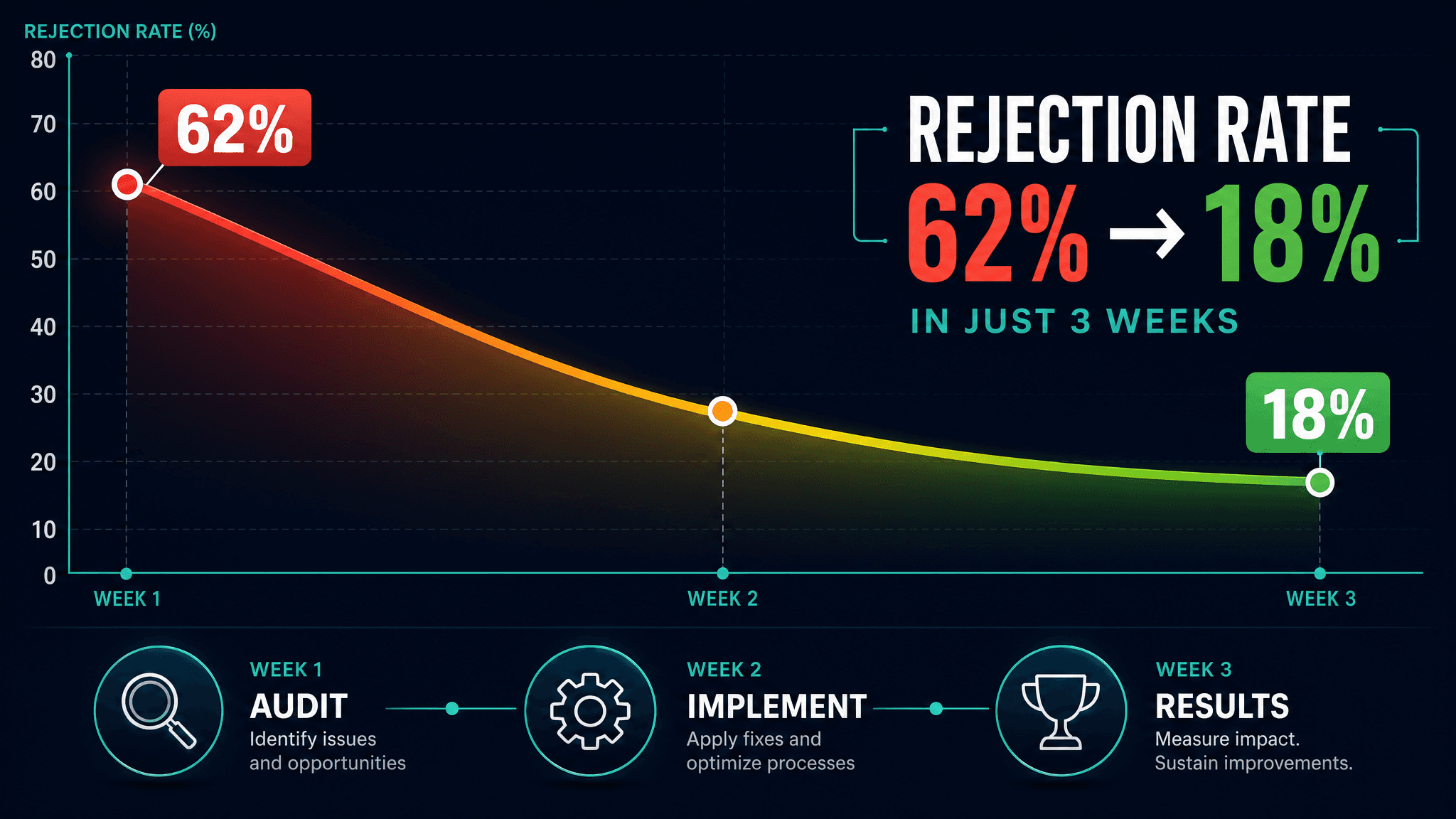
The biggest time-sink was the TrafficJunky rejection lag. We integrated Hawtads’ compliance engine, which is trained on the specific guidelines of major adult networks. Before a single pixel was uploaded to the TJ dashboard, the ads were scanned for common rejection triggers (excessive skin ratios, prohibited text-to-image ratios, and "misleading" UI elements). This dropped the rejection rate from 30% to under 5%, effectively giving the team back two days of "live time" every week.
3. Format-Specific Variants
Most advertisers "resize" their ads. They take a 300x250 and squash it into a 300x100. This is a mistake. Adult banner ad performance relies on the visual weight of the creative within its specific context. We used the platform to generate layout-specific variants. The 300x100s were optimized for horizontal eye-flow, while the 300x250s focused on a central "hero" focal point. This ensured that no matter where the ad appeared, it looked native to that placement.
4. Weekly Data-Driven Iteration
Instead of a monthly "creative refresh," we moved to a 7-day cycle. Every Tuesday, the bottom 20% of creatives were killed and replaced with new AI-generated variants based on the top 20% performers. This prevented the TrafficJunky case study standard of "the Week 3 dip," where performance usually falls off a cliff as the audience tunes out the creative.
Section 3: The Results (Week-by-Week Breakdown)
The transition wasn't an overnight miracle. It was a compounding gain. Here is how the trafficjunky high ctr ads project unfolded:
Week 1: Migration and Setup
In the first week, we saw a slight dip in CTR (0.07%). This is normal. The media buyer was adjusting to the new workflow, and we were flushing out the old, fatigued creatives. The focus was on building the first "super-batch" of 20 compliant ads.
Week 2: The First AI Variants Go Live
With 18 new variants in rotation, the "winner" started to emerge. We noticed that a specific "minimalist" aesthetic was outperforming the traditional "busy" adult banners. By the end of Week 2, CTR climbed to 0.12%. The media buyer noted: "For the first time, we had enough data to see that our 'best' designer-made ad was actually our third-worst performer overall."
Week 3: Volume Kicks In
This was the turning point. With the compliance pre-checks, every ad we uploaded was approved within hours. We doubled down on the winning minimalist style from Week 2, generating 15 more iterations of that specific look. CTR hit 0.19%. Volume allowed us to dominate the auction—higher CTR meant a better "Quality Score" in the TJ algorithm, leading to better placements for the same bid.
Week 4: Stabilization and Scale
By Week 4, the account had stabilized. We weren't just seeing trafficjunky high ctr ads; we were seeing a 40% conversion lift on the landing page because the creative was better pre-qualifying the traffic. The final CTR settled at 0.24%.
The Comparison Table
| Metric | Baseline (Manual) | Week 4 (Hawtads) | Improvement |
|---|---|---|---|
| Click-Through Rate (CTR) | 0.08% | 0.24% | 300% |
| Ads Produced / Week | 4 | 18 | 4.5x Volume |
| TJ Rejection Rate | 30% | <5% | -83% Friction |
| Conversion Rate Lift | - | +40% | Significant ROI Gain |
Section 4: Why This Worked (The Principles)
It’s easy to credit "AI" and leave it at that, but the success of this trafficjunky case study wasn't just about the tech—it was about the fundamental principles of media buying in regulated industries.
1. Creative Volume is the Only Real Lever: In a mature network like TrafficJunky, you aren't going to "out-target" your competition. Everyone has access to the same segments. The only way to win is to out-test them. By increasing volume by 4.5x, we increased the probability of finding a "unicorn" creative by the same margin.
2. Compliance Speed as a Competitive Advantage: Every hour your ad sits in "Pending Review" is an hour your competitor is buying your traffic. By using automated pre-checks, we eliminated the back-and-forth. Compliance isn't a chore; it's a speed-to-market strategy.
3. Format-Specific Optimization: A 300x250 is a story; a 300x100 is a shout. Treating them as different channels rather than just different sizes allowed the AI to optimize for the specific user behavior associated with those spots.
4. Data-Driven Iteration Frequency: Creative fatigue in the adult vertical happens fast—sometimes in as little as 72 hours for high-spend spots. A monthly refresh is a recipe for burning money. Weekly, data-backed refreshes kept the CTR "floor" much higher than the baseline.
"Here's what the media buyer actually said when they saw the Week 4 numbers: 'I used to spend my Mondays arguing with designers. Now I spend my Mondays picking which winning variant to scale. It’s a completely different job.'"
FAQ
Does this work for non-adult verticals?
Absolutely. While this case study focused on adult banner ad performance, the principles apply to any regulated or "high-friction" industry, such as iGaming, Nutra, or Finance. Any vertical where compliance is a bottleneck and creative fatigue is high will see similar results from this workflow.
What about brand safety concerns?
The AI is trained on your specific brand guidelines. Unlike generic generators, our platform allows you to set "hard rails" for what can and cannot be produced. This ensures that even at high volumes, every ad stays within your brand's safety parameters while remaining aggressive enough to convert.
How much time does it take to set up?
Most advertisers are up and running within 48 hours. The integration involves connecting your existing asset library and defining your compliance rules. From there, the AI begins generating variants immediately.
P.S. We're publishing one anonymized case study a month. Subscribe to our newsletter to get the next one delivered straight to your inbox.
Get the next case study
Join 5,000+ media buyers getting data-dense insights every month.