TrafficJunky vs ExoClick Pricing & Creatives 2026
The $5,000 Burn: Why Your Creative Strategy is Killing Your ROIImagine this: You’ve just loaded $5,000 into your advertising accounts. You’ve split the budget across TrafficJunky, ExoClick, and JuicyAds. You’ve got a "winning" offer, a solid landing page, and a tracking setup that would make…
$5,000 split three ways settles the question quickly. Run the same 300x250 banner on TrafficJunky, ExoClick and JuicyAds, and by Thursday the auctions have answered: a click-through rate near 0.03 percent, a cost per click climbing because the system has scored the ad as low relevance, and a budget that disappears without buying information.
The offer was fine. The creative was invisible, and one file cannot compete in three different auctions.
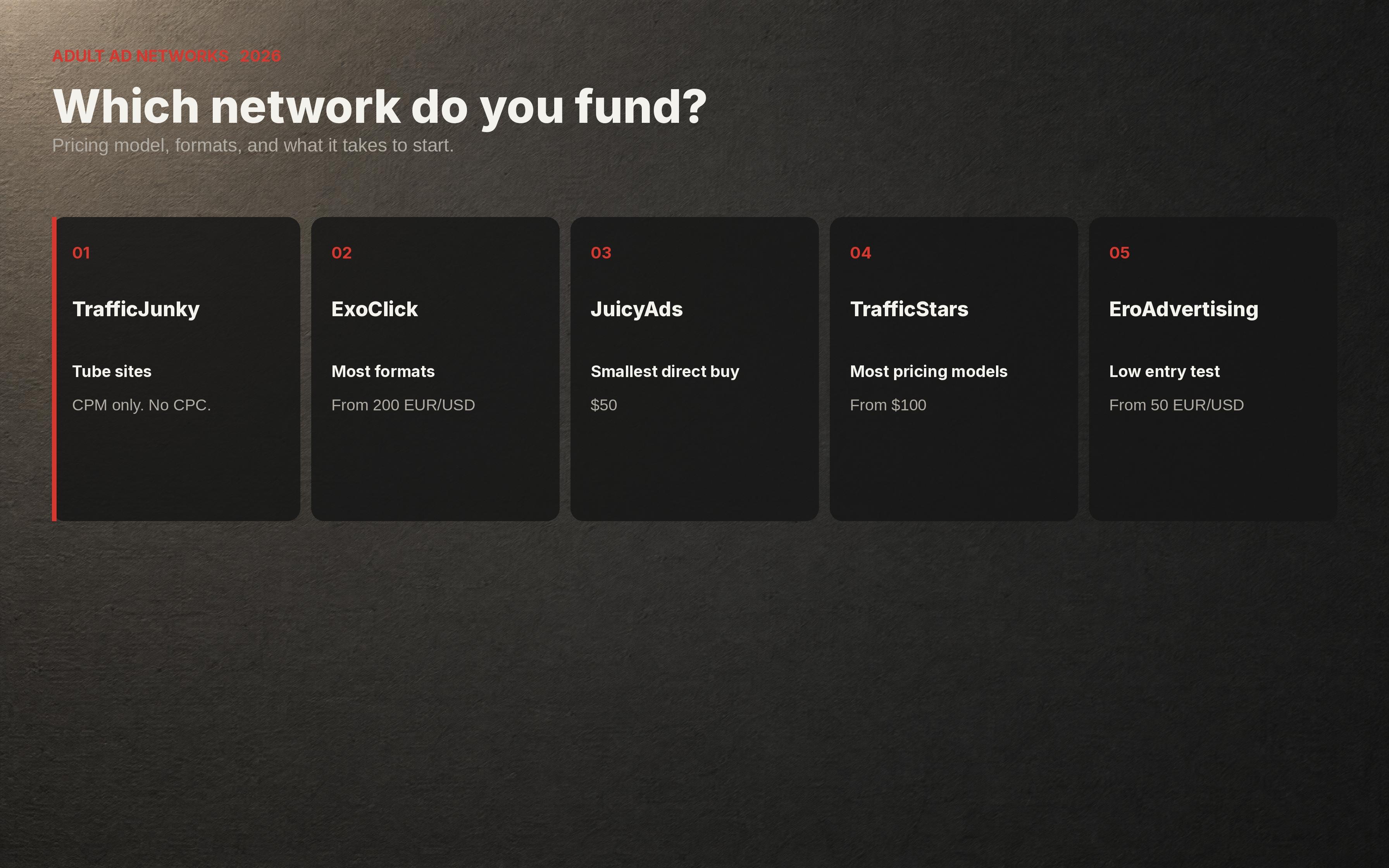
Each network asks for something different. TrafficJunky sells exclusive inventory inside a premium walled garden. ExoClick sells volume across thousands of publishers and a dozen formats. JuicyAds sells hand-picked placements in specific niches. What works on one underperforms on the next, and a plan that ignores the difference is not media buying.
Here is what each platform demands in 2026, which one punishes weak creative hardest, and how to produce for all three without spending forty hours a week in Photoshop.
TrafficJunky: exclusive inventory, higher creative bar
TrafficJunky is the exclusive advertising network for the MindGeek (now Aylo) ecosystem. If you want Pornhub, RedTube or YouPorn, you buy through TrafficJunky. Because the network owns its inventory, the targeting data is granular, and the competition for it is fierce.
TrafficJunky sells its own inventory across a very large logged-in audience, which is where the high-intent behavior comes from.
Users arrive with a purpose, and that raises the bar on the file. A pixelated or generic image reads as a broken ad. The bidding system rewards click-through rate, so a lazy creative costs more per click than a good one. On this network, boring is expensive.
TrafficJunky creative specs
- Formats: 300x250 (medium rectangle), 300x100 (boutique) and 950x250 (billboard).
- Video: outstream and in-stream placements reward production value. Your ad competes with the content the user came to watch.
- Register: professional, exclusive, high resolution. Premium brand rather than clickbait.
ExoClick: the volume network
ExoClick runs native, video, push notifications and interstitials, which is why its inventory looks different from one placement to the next.
Its traffic runs from premium tube sites to file-sharing pages, sometimes within the same hour. That range is a production problem before it is a targeting problem. A display-banner-only plan uses one format out of the four the network sells, and native is where the growth has been.
ExoClick creative specs
- Native: a thumbnail at 300x300 or 1200x627, plus a headline that reads like a recommended video or a breaking news item.
- Push: a small icon and a larger image, built to look like a message or an alert, because that is how the user meets it.
- Register: volume. Ten to twenty variations is a normal test on this network.
JuicyAds: the marketplace
JuicyAds calls itself "The Sexiest Advertising Network" and operates more like a marketplace than a programmatic exchange. Direct-buy style placements are common and the publisher base is loyal. The marketplace is the point: buyers hand-pick the sites that fit their niche rather than bidding blind across an exchange.
Traffic here is narrow by design. Where TrafficJunky rewards broad premium appeal, JuicyAds rewards a creative that speaks to one audience without apologizing for it.
JuicyAds creative specs
- Banners: 300x250 and 468x60 remain the workhorse sizes.
- Pop-unders: when you buy pops, the landing page does the creative work. It has to load in under two seconds and carry one clear call to action.
- Register: niche-specific, bold and direct. Bright color and high contrast earn their place here.
The secondary networks
The three largest networks absorb most of the attention. Buyers who test further out find cheaper traffic and less competition, with creative quirks of their own.
- TrafficStars: strong for xHamster traffic, close to TrafficJunky in quality expectations, more permissive about aggressive native styles.
- ClickAdilla: premium traffic sources and a strict approval process, so the assets have to be clean and compliant before submission.
- AdMaven and RichAds: push and pop inventory. Creative here has to look like a notification: simple, urgent and focused on a single action.
- Adsterra: Social Bar and In-Page Push, two formats with aspect ratios that banner tools rarely handle without distortion.
Sixty assets is the real brief
Five variations per format per network is the working minimum. Three networks, four formats, five variations is 60 files for one offer. The arithmetic is where most media buyers discover that the bottleneck is in production.
The set also has to arrive together. Teams that test TrafficJunky in week one and reach ExoClick in week four are not comparing networks. They are comparing a finished campaign against an old one, and the second result tells them nothing about the creative.
There are three conventional routes, and each carries a cost the media plan rarely shows.
Freelance designers
You send a brief. Three days later version one arrives. You ask for revisions, two more days pass, and by the time 60 assets exist the trend has moved or a competitor has saturated the offer. At $10 to $20 a banner, the set costs $600 to $1,200 before a single impression runs.
Agencies
Specialist creative agencies produce good work at around $3,000 a month, with two weeks of onboarding before the first file. That is a reasonable trade for a brand campaign and a bad one for performance marketing, where the plan is to test and kill fast.
Generic AI image tools
A general image generator does not know what compliance means. It does not know that a 300x250 banner and a 1200x627 native unit are different products. It also draws six-fingered hands, and the TrafficJunky review team rejects those.
Where HawtAds fits
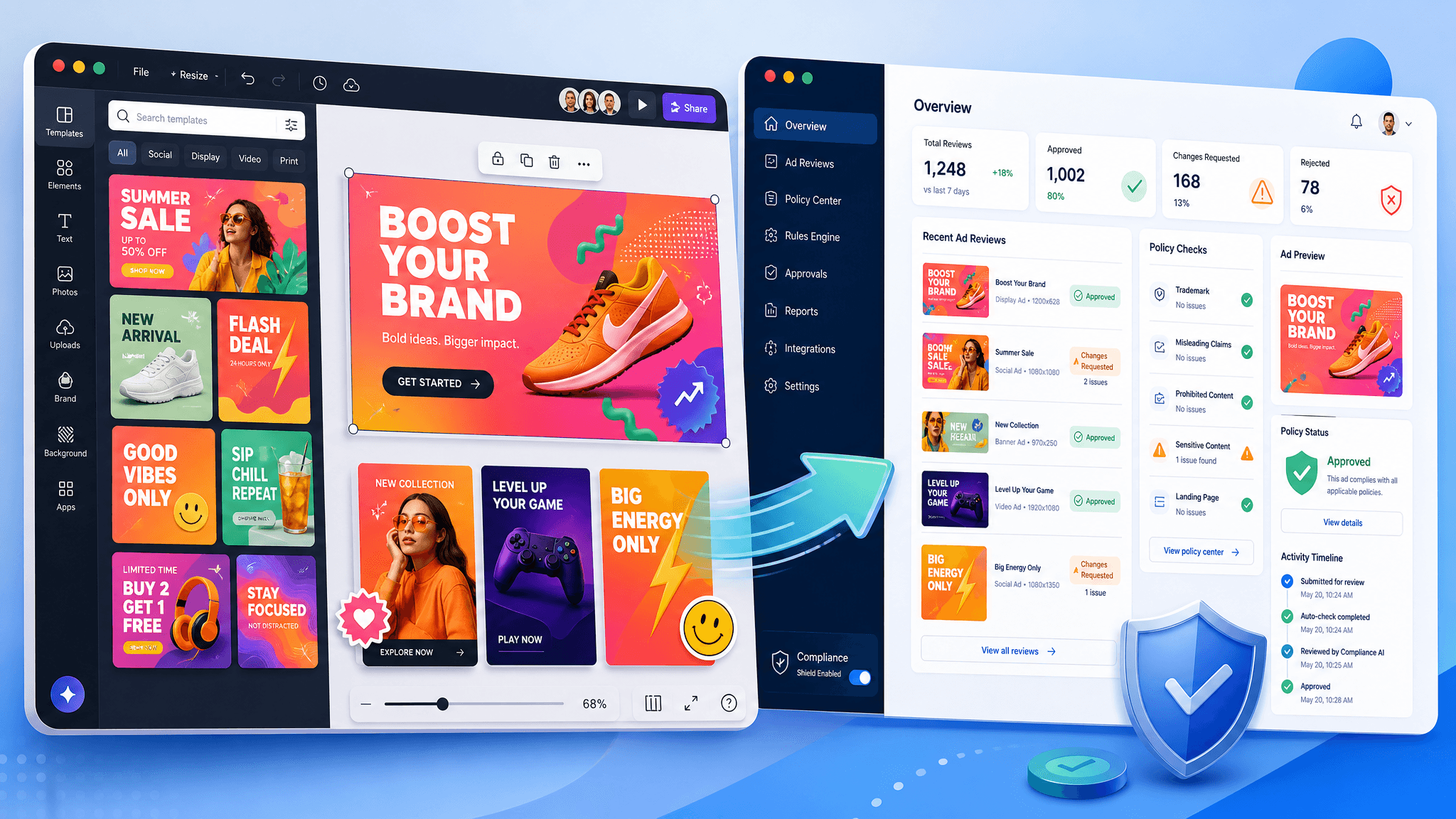
HawtAds is a general ad creation tool, with additional features for regulated verticals. For a media buyer, the useful part is that the platform already holds the spec sheet and the approval rules for each network, so the brief starts with the goal and the destination instead of a folder of dimension notes.
The workflow is four steps:
- Set the goal: tell the system what you are promoting: dating, gaming, nutra or another category.
- Choose the platform: TrafficJunky, ExoClick, JuicyAds or another major network. The specs and rules for that destination come with the selection.
- Generate: the system produces the visuals and headlines for that platform's register rather than a generic house style.
- Scale: ask for 50 variations and get them in seconds rather than days.
The output is a finished file at the size the placement accepts, in under 10 minutes. That leaves the buyer's time for the work that cannot be automated: reading the data and scaling what wins.
The alternative is what most teams settle for: one strong file per network and a handful of sizes. That is enough to run a campaign and not enough to learn from one, because at five variations the test decides which file survived. It cannot tell you which idea worked.
The arithmetic
A serious media buyer's hour is worth at least $100. Ten hours a week in Canva or on freelancer revisions is $1,000 a week of production time, before any asset is bought.
Freelancer route:
- 10 banners: $150
- Turnaround: 3 to 5 days
- Quality: variable
- Monthly cost: $600 or more
HawtAds route:
- Banners: unlimited within the subscription
- Turnaround: 10 minutes
- Quality: built to the placement and the policy
- Monthly cost: one flat subscription fee
The second route costs less and moves faster in the only place speed matters, which is the number of tests that fit inside a trend. On TrafficJunky and ExoClick, the buyer who tests the most creative before the offer saturates usually wins the auction.
Which platform needs better creative?
TrafficJunky punishes weak visual quality hardest, because its inventory is premium and its users are engaged. ExoClick punishes a single-format plan, because its inventory spans more formats than most teams can fill. JuicyAds punishes a generic message, because its buyers hand-pick sites for a niche.
All three punish the same habit: one asset reused everywhere and called a strategy. A single banner and a set-and-forget campaign is now an expensive way to learn nothing.
The practical answer for 2026 is a production line that can turn one approved offer into 60 files, each built for the network it will run on, without a designer in the loop for every size. That is the capability the auction is actually charging you for.
Ready to produce creatives for every platform in under 10 minutes each?
Start your HawtAds subscription →
Produce the next test set at HawtAds.com and put the budget into traffic instead of production.