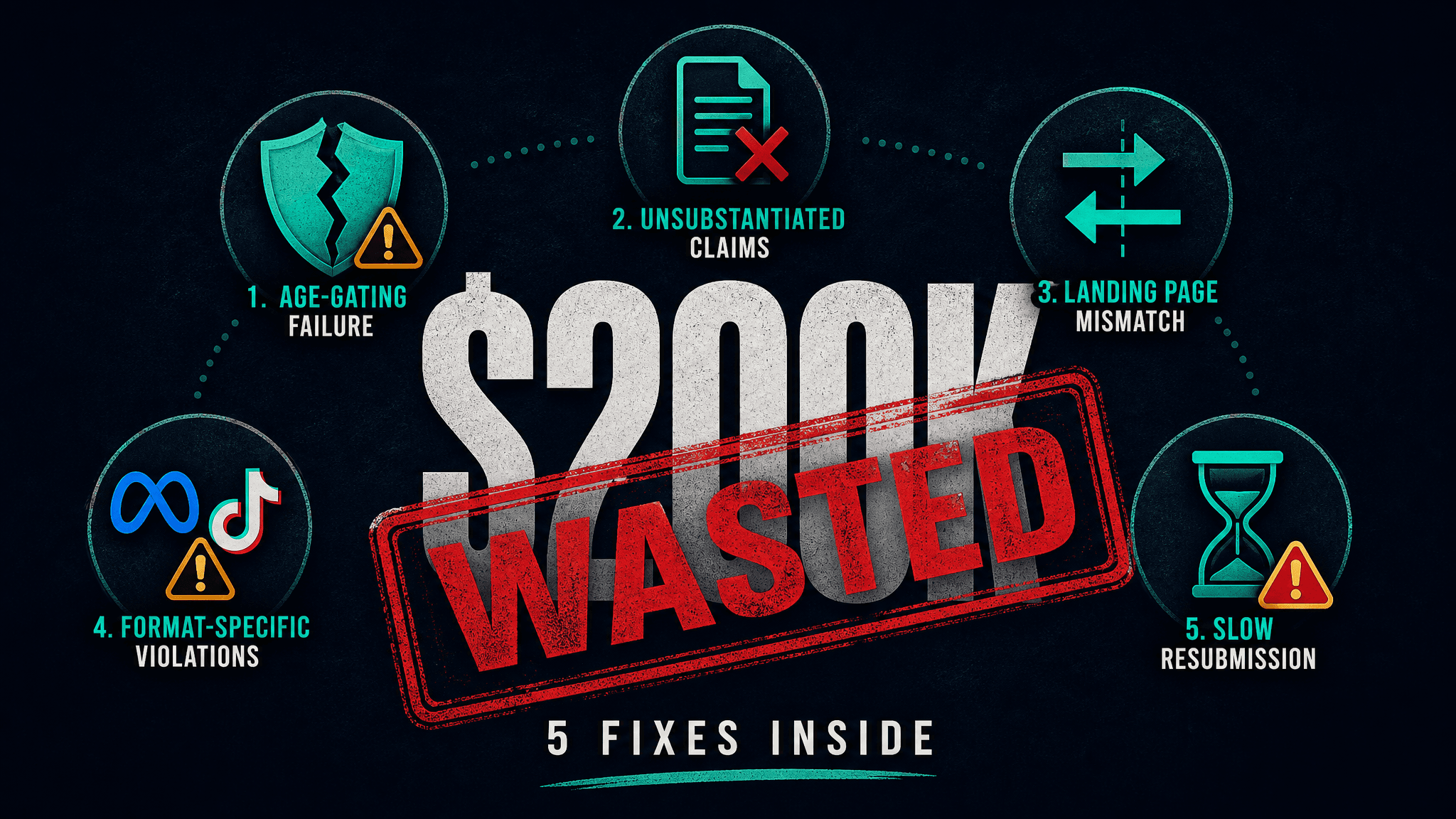
Why 73% of Ads in Regulated Industries Get Rejected (And How to Fix It)
Five checks that catch most first-pass rejectionsMost first-pass rejections in regulated categories come from five patterns, in FinTech, pharma, real estate and gaming alike. None of them is a creativity problem, and every one of them can be checked before upload. Take them in o…
Five checks that catch most first-pass rejections
Most first-pass rejections in regulated categories come from five patterns, in FinTech, pharma, real estate and gaming alike. None of them is a creativity problem, and every one of them can be checked before upload.
Take them in order. Each one is a sentence or an image you can fix in minutes, and each one costs a launch window when it is caught after submission instead.
What the reviewer actually sees
Meta, Google, LinkedIn and TikTok review regulated ads with systems tuned for liability. A sock ad that misleads costs someone itchy feet. A FinTech ad that misleads can cost someone their savings, and the platform carries part of that risk. The same asymmetry explains why your account feels held to a different standard than the D2C brand next to you in the auction.
The first reviewer is an automated classifier, not a person. It matches the words, the images and the landing page against patterns it was trained to flag, and it does that in milliseconds. It does not know your license, your reputation or your record without a complaint. It knows what the copy says and what the picture shows.
That is why the rejection notice is usually vague. "Policy violation" is the output of a match, not an explanation. Your job before upload is to find the match yourself, because you can see the context and the classifier cannot.
A rejection also costs you the next slot. The campaign misses its learning phase, the creative team loses a week, and the resubmission arrives with less runway before the launch date. The pre-upload check is the cheaper half of the same job.
1. Absolute claims
Words like "guaranteed," "risk-free" and "instant" are the fastest route to a flag. A savings account ad that promises to "guarantee your financial future" reads as an unbackable claim, because no financial product can guarantee an outcome for every customer.
Absolute language is the most common trigger in financial services. The classifier is looking for a definitive claim that no single customer experience could support. It does not evaluate intent, and it does not care that the line tested well with a focus group.
The fix is to move from what will happen to what is possible: "designed to," "aims to," "potential." A live ad that is 10% less punchy beats a perfect ad that never runs, and the difference in click-through is usually smaller than the difference in approval rate.
Read the copy once with the absolutes highlighted. Every highlighted word is a decision: replace it, qualify it, or accept the rejection risk on purpose.
2. Personal attributes
Meta's advertising standards are specific: "ads must not contain content that asserts or implies personal attributes. This includes direct or indirect assertions or implications about a person's race, ethnicity, religion, beliefs, age, sexual orientation or practices, gender identity, disability, physical or mental health (including medical conditions), vulnerable financial status, voting status, membership in a trade union, criminal record, or name." "Struggling with credit card debt? We can help" fails that test. The word "you" next to "debt" asserts that the reader has debt, and the platform treats the assertion as a privacy violation.
The classifiers have become better at the grammar of the problem, which means the old trick of softening one word no longer works. The construction has to change, not the adjective.
Write to the problem instead of the person. "New options for managing chronic pain" describes a category. "Are you tired of back pain?" describes the reader. The second one converts slightly better in a vacuum and is the one that gets the account restricted.
One test before upload: cover the product name and read the headline. If the sentence only makes sense when the reader has the condition, the sentence is about the reader.
3. Restricted products, including the legal ones
CBD, supplements and pharmaceuticals meet a global floor. If a product is restricted in one major market, the platform applies its strictest setting everywhere, so a product that is legal in your jurisdiction can still be unsellable in the auction.
The visual side is where teams get surprised. A wellness brand had an ad rejected because a fern in the background read as a hemp leaf at low resolution. The classifier does pattern matching, not botany.
About 1 in 4 health ads fail on unproven medical claims or prohibited content phrasing, usually because the copy names a condition the platform reserves for certified providers. The line between "general wellness" and "medical treatment" is narrow, and it moves by platform.
Use general wellness language, and check the imagery at the size the feed will serve it. A shape that is unambiguous at full resolution can read as a different object in a thumbnail.
4. Missing disclosures
The ad includes the fine print. In real estate, a missing Equal Housing Opportunity logo or license number is enough to fail, and the misses are usually local disclosures nobody put in the template.
Hiding the text in a small font does not help. OCR reads it and flags it as unclear or deceptive, and a disclosure that cannot be read is treated as a disclosure that was never made.
The conflict is familiar: the creative director wants a clean frame, legal wants a wall of text, and the compromise lands somewhere too small to survive a mobile crop. Treat the disclaimer as a design element instead. Give it a fixed position in the template, a legible size, and enough contrast that a screenshot of the ad still reads.
If the platform cannot read it, the platform assumes it is not there.
5. A landing page that tells a different story
Approval of the creative is not approval of the funnel. The crawler follows the click, and a large share of policy violations in regulated sectors happen after it. An ad promising "financial tips" that lands on a crypto trading pitch triggers a circumventing-systems violation, and the account goes down two hours after the ad went live.
The check is continuity of experience. The offer, the tone and the disclosures on the page have to match the ad that sent the visitor there. A page that oversells the promise reads as a bait and switch, even when the ad itself was conservative.
Every claim on the landing page needs the same evidence as the ad. If the ad says "designed to help," the page cannot say "will fix." The inconsistency is what the crawler records.
Run the ad copy and the page copy through the same check. Most teams review them in different meetings and never read the two side by side.
Consistency is a survival strategy before it is a branding one.
The 40-hour month
Marketing teams in regulated industries lose a working week a month to compliance reviews and fixing rejected ads, and that is a week spent on rework instead of growth.
The hours are easy to underestimate because they are spread across people. A designer re-exports 50 sizes with a new disclaimer. A copywriter rewrites the same headline for the third time. A media buyer waits a day for an approval that arrives after the peak. Nobody logs the total, so nobody budgets for it.
The queue also hides its own cost. An ad that waits three days for approval usually needed one change, and that change could have been made before the file left the designer's machine. Speed comes from the first draft, not from the reviewer.
Multiply the hours by your blended rate, then add the campaigns that did not run during a peak window. The second number is usually larger than the payroll number, and it never appears in a report.
Most of the work is repetitive: the same personal-attribute error for the tenth time, the same disclaimer pasted onto 50 image sizes. The ads that do get approved are the ones that reach the market. The advertisers behind them are not smarter. They catch the flag before upload instead of after.
How to run the check in ten minutes
You do not need a new process to catch most of this. You need one pass over the asset before it enters the queue, done by the person who made it.
- Read the headline and the first line of body copy aloud. Highlight every absolute and every "you" attached to a sensitive condition.
- Confirm the disclosure is present, legible at mobile size, and close to the claim it qualifies.
- Open the landing page on a phone. Check that the promise matches, and that the privacy policy and terms links resolve.
- Look at the image at thumbnail size. Ask what a classifier with no context would name.
- Check the channel's category rules for this product. Certification requirements are cheaper to meet before upload.
Ten minutes per asset against a week a month of rework is an easy trade. The check does not need to be perfect to remove most of the volume.
What changed when we built the check into the tool
A rejection rate that high is a workflow failure, not a creative one. We built HawtAds so the policy check runs while the ad is being made, not after a rejection notice arrives. The system flags a risky phrase, proposes a compliant alternative, and confirms the required disclosures are placed and legible.
HawtAds is a general ad creation tool, with additional features for regulated verticals. The compliance layer runs on the same rules the platforms publish, and it updates when they do.
You can see it on your own creative. Book a demo and bring one of the ads that got rejected.