Stop Paying for Canva to Get Your Ads Rejected
Stop Paying for Canva to Get Your Ads RejectedYou bought Canva because it’s $13/mo. Then you spent 6 hours rebuilding three rejected alcohol ads on a Friday night while your friends were out. That is the real monthly price of "cheap" design tools. Let’s be honest: Canva is a…
Stop Paying for Canva to Get Your Ads Rejected
You bought Canva because it’s $13/mo. Then you spent 6 hours rebuilding three rejected alcohol ads on a Friday night while your friends were out. That is the real monthly price of "cheap" design tools.
Let’s be honest: Canva is a miracle for wedding invitations and Instagram stories about your weekend latte. But for a regulated advertiser in CBD, gaming, alcohol, or finance? It’s a liability disguised as a bargain.
You aren't just paying for a subscription. You are paying for the time it takes to manually check every line of copy against state-by-state regulations. You’re paying for the 3 AM design rotations when Meta flags your creative for "unacceptable business practices." You’re paying for the $50,000-a-year junior designer who spends 70% of their week resizing boxes instead of thinking about strategy.
You’re not a designer. You’re a firefighter. And the fire is your ad account’s "Rejected" status. It’s time to stop using a generic art tool and start using a compliance engine.
1. The "Compliance Blind Spot" Costs You More Than a Subscription
Canva doesn’t know the difference between a vitamin supplement and a pharmaceutical drug. It doesn't know that your CBD ad needs a specific disclaimer in Texas but a different one in New York. It’s a blank canvas—and in a regulated industry, a blank canvas is a trap.
When you use a generic canva alternative ad creative tool that lacks industry intelligence, the burden of compliance is 100% on you. You have to keep a 40-page PDF of platform policies open in one tab and your design in another. Here is the actual math: if you spend 2 hours per week researching policy updates to avoid rejection, that’s 100 hours a year. At a $50/hour internal rate, that’s $5,000 in hidden labor costs just to make sure your $13/mo tool doesn't get you banned.
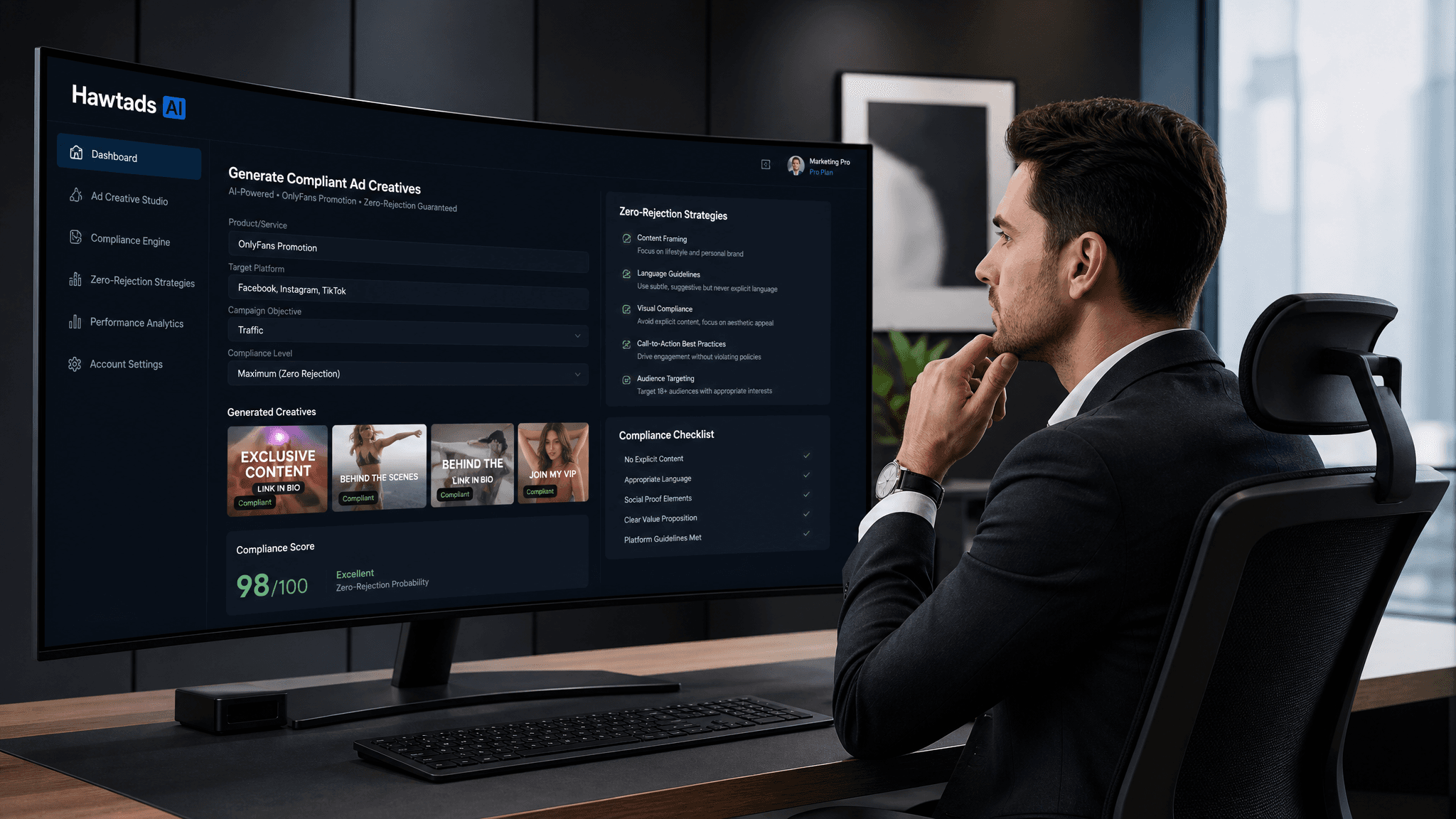
Hawtads isn't just a design tool; it’s an ad compliance tool. It knows the rules so you don't have to. While you're dragging and dropping elements in Canva, Hawtads is actively scanning your creative against current Meta, Google, and state-level regulations.
2. Version Hell: The $2,400 Resizing Tax
You know the drill. You make a perfect 1080x1080 square for Instagram. Now you need a 9:16 for Stories. Then a 1.91:1 for Facebook Feed. Then three more versions for Google Display. In Canva, "Magic Switch" helps, but it still requires manual adjustment for every single element to make it look professional.
You are wasting 15-20 minutes per creative variant. If you’re running a modest campaign with 5 concepts and 4 formats each, that’s nearly 7 hours of "box shifting." If you do this twice a month, you’re burning $8,400 worth of billable time annually on work a machine should be doing in seconds.
This is the primary reason teams look for a canva vs compliance-grade AI ad platform comparison. One is a tool for making things look "nice"; the other is a system for making things work at scale.
3. The Account Suspension "Death Penalty"
Let’s talk about the nightmare scenario: the permanent ban. Meta and Google don't give you three strikes anymore. If you repeatedly submit ads that violate their nuanced policies—even by accident—they will throttle your reach or kill your account entirely.
Canva doesn't care if your ad account gets suspended. They already got your $13. But for your business, an account suspension is a catastrophic event. It’s weeks of lost revenue, hundreds of hours in support tickets, and the permanent loss of pixel data.
The "cheap" tool becomes the most expensive mistake you’ve ever made when it allows a non-compliant ad to slip through to the reviewer. Using an ai ad tool vs canva means having a safety net that flags high-risk words or imagery before you ever hit "Submit."
4. The Design-to-Legal Ping Pong Match
In most regulated agencies, the workflow looks like this:
- Designer creates something in Canva.
- Designer sends a link to the Media Buyer.
- Media Buyer sends a screenshot to the Legal Team.
- Legal Team marks it up with "No, you can't say 'Risk-Free'."
- Designer goes back into Canva to fix it.
This cycle repeats 3-4 times per ad. It’s slow, it’s demoralizing, and it’s a massive bottleneck.
When you use a professional compliance workflow, the rules are baked into the creation process. Legal doesn't have to play "Where's Waldo" with compliance errors because the platform won't let the designer export a non-compliant file in the first place. You’re cutting the approval time from 4 days to 4 minutes.
5. The Opportunity Cost of Slow Iteration
In 2024, ad performance is a volume game. The winner isn't the person with the "best" ad; it’s the person who tested 50 variations to find the 2 that actually convert.
Canva is too slow for high-volume testing. If it takes your team 2 hours to produce a new batch of creatives, you’re only going to test a handful of ideas. You’re leaving money on the table because you’re limited by your design bandwidth.
With Hawtads, you can generate 50 compliant, high-performing variations in the time it takes to brew a pot of coffee. The math is simple: More variations = more chances to find a winner = lower Customer Acquisition Cost (CAC). If you can lower your CAC by just 10% through better testing, that’s worth tens of thousands of dollars. Canva can't do that for you.
Canva vs. Hawtads: The Regulated Advertiser’s Reality
| Feature | Canva | Hawtads |
|---|---|---|
| Compliance Engine | None. You are the engine. | AI-powered, policy-aware scanning. |
| Batch Generation | One by one (mostly). | Hundreds of variants in seconds. |
| Regulated Industries | Generic templates. | Tailored for CBD, Alcohol, FinTech, etc. |
| Approval Workflow | Email/Slack ping-pong. | Integrated audit trails. |
What to do instead: The Professional Pivot
Stop treating your ad creative like a craft project. It is a financial instrument. If you are spending more than $2,000 a month on ad spend, the "savings" from using Canva are being eaten alive by inefficiency and risk.
The solution isn't to hire more designers—it's to give your current team better tools. You need a platform that understands the hawtads vs canva distinction: Canva is for making, Hawtads is for scaling.
Check out our pricing plans to see how we fit into your growth strategy. Most teams find that Hawtads pays for itself within the first three days of a new campaign launch just by eliminating the "rejection loop."
FAQ: Everything you’re thinking right now
Is Canva bad for all advertisers?
No. If you’re a local florist or a life coach, Canva is fantastic. But if your industry has a "Compliance" department, Canva is the wrong tool for the job.
What if my team already uses Canva?
Keep it for your organic social posts and internal decks. Use Hawtads for your paid media. Don't let your "easy" tool become the bottleneck for your revenue-generating channels.
Does Hawtads replace designers?
No, it frees them. Instead of spending 5 hours resizing a banner for the 10th time, your designer can actually focus on the big ideas and creative strategy that move the needle.
How long does it take to switch?
You can generate your first compliant ad set in under 10 minutes. There is no "onboarding" month. It's a plug-and-play solution for people who are tired of losing sleep over ad rejections.
Hawtads was built to solve the specific pain of regulated advertising. We handle the policy updates, the automated formatting, and the compliance checks so you can focus on what actually matters: ROI. It's time to graduate from generic design tools to a platform built for the way you actually work.
→ Start the 7-day free trial. No card.
P.S. If Canva is working for your team—keep it. This post is for the 70% of regulated-vertical advertisers it isn't working for.