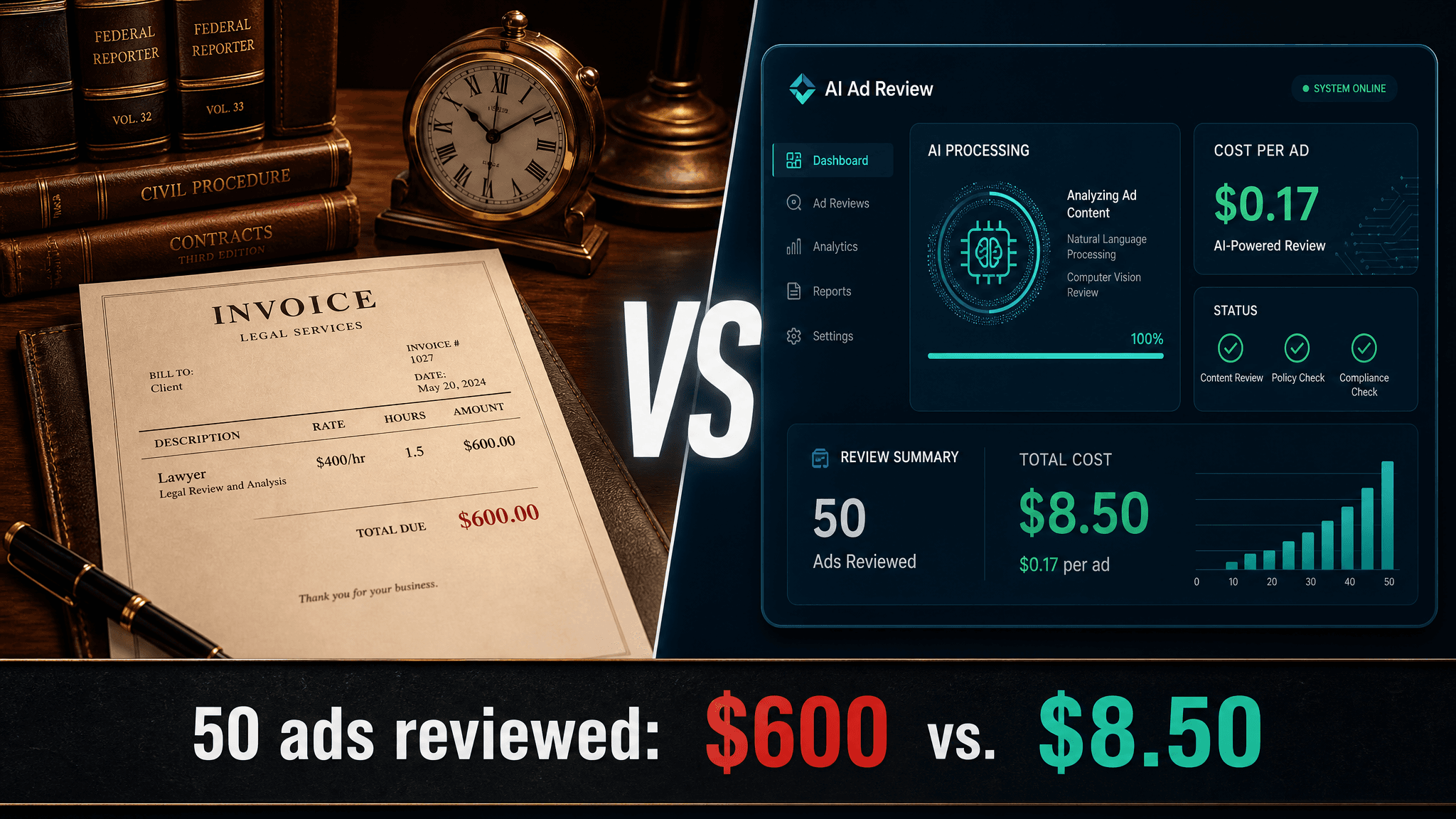
The True Cost of Social Casino Ad Compliance in 2026: AI vs Agency vs Legal
Social casino ad compliance 2026 costs are rising; compare AI vs. Agency vs. Legal models to save 70% on overhead and stop ad rejections today.
Social casino ad compliance 2026 requires a budget allocation that keeps growing, driven largely by Google and Meta’s sophisticated automated flagging systems that now penalize "borderline" content with account-level shadowbans. For the modern operator, the cost of staying live is no longer just a line item—it is a strategic barrier to entry. We have moved past the era where a simple "18+" disclaimer was enough to clear a creative; today, the intersection of sweepstakes mechanics and real-money gaming (RMG) optics has created a regulatory minefield that human review alone cannot navigate profitably.
The "before" state for most performance teams is a grind of manual review cycles: sending a pack of 20 videos to a legal firm, waiting four days for redlines that kill the hook, and eventually seeing them rejected anyway because the platform's AI interpreted a gold coin animation as an RMG violation. The "after" state is a streamlined, automated pipeline where creative is validated against the latest social casino google ads policy 2026 in real-time, allowing media buyers to spend their time optimizing ROAS rather than arguing with compliance officers. Getting there requires an honest look at the three primary ways to handle compliance: AI, Agencies, and Legal counsel.
The Shifting Landscape: Why 2026 is Different
In 2026, the distinction between "social" and "gambling" has blurred in the eyes of regulators. Whether you are running a classic social casino or a sweepstakes model, the scrutiny on ad creative has reached an all-time high. Platforms are under pressure from global regulators to prevent "predatory" creative, leading to the implementation of more aggressive AI scanners that look for specific visual triggers: high-frequency flashing, specific coin-clinking audio frequencies, and even certain types of "big win" animations that mimic real-money payouts too closely.
Furthermore, gambling ad regulations by country have become increasingly fragmented. What passes in the US sweepstakes market will trigger an immediate ban in the UK or Australia without a specific social casino advertising certification. If your compliance strategy is "one size fits all," you are effectively burning your ad spend on high-CPM traffic that will never convert because your landing pages are being throttled by platform algorithms.
1. The Legal Route: High Precision, High Friction
For many CFOs, "Legal" is the default safety net. You hire a specialized firm to review every frame of every ad. While this offers the highest level of risk mitigation, it is the most expensive and slowest method available in 2026.
The Financial Breakdown
- Hourly Rates: Specialized iGaming and sweepstakes attorneys bill by the hour, at rates that reflect the specialism.
- Turnaround Time: 48 to 72 hours per batch of creative. In the fast-moving world of social media trends, a 72-hour delay means your "trending" hook is already stale.
- Monthly Cost: For an operator producing 50 new creative assets a month, legal review can easily top $20,000 monthly, excluding the cost of the internal team managing the back-and-forth.
The real cost of the legal route isn't just the invoice; it's the opportunity cost. If your competitors are testing five new hooks a day while you’re waiting for a partner at a law firm to approve a "Play Now" button, you’ve already lost the auction. Legal counsel is essential for high-level strategy and technical playbooks on age-gating, but using them for creative review is like using a scalpel to mow a lawn.
2. The Agency Route: Outsourcing the Headache
Many social casino operators opt to hire specialized performance agencies that "handle compliance" as part of their management fee. This sounds like a win-win, but the incentives are often misaligned.
The Reality of Agency Compliance
Agencies typically charge a percentage of ad spend (usually 10-15%) or a heavy monthly retainer. While they claim to be experts in sweepstakes casino ad compliance, their primary goal is to keep the spend high. This often leads to one of two outcomes:
- The "Safe" Creative Trap: To avoid rejections, the agency produces incredibly bland, low-performing ads that are "safe" but fail to convert. You aren't getting banned, but you aren't getting players either.
- The Trial and Error Method: The agency throws creative at the wall to see what sticks. When an account gets flagged, they simply move to a new "backup" account. This is a dangerous game in 2026, as Meta and Google have become much better at identifying "entity-level" violations, potentially leading to a permanent ban of your entire business manager.
The cost here is hidden in the management fee. If you are spending $500,000 a month, you are paying $50,000 to $75,000 for "management" that may or may not actually be protecting your brand long-term.
3. The AI Route: Automation as a Compliance Layer
By 2026, AI-powered automation has become the only way to scale social casino creative without ballooning overhead. Platforms like Hawtads allow teams to pre-screen creative against social casino google ads policy 2026 before the "upload" button is even clicked.
The Direct Savings
Unlike the legal or agency routes, AI compliance is a fixed, scalable cost. Instead of paying per hour or as a percentage of spend, you are paying for the technology. AI pre-screening catches the problems before submission, which has a massive ripple effect on your bottom line. Every rejected ad is wasted production time and a "strike" against your account health.
Key Advantages of the AI Model:
- Instant Feedback: Get a "Pass/Fail" on a video in seconds, not days. If the AI detects a prohibited "cash-out" animation, the editor can fix it immediately.
- Consistency: Human reviewers have "off" days. AI doesn't. It applies the same rigorous standards to every frame, ensuring your social casino ad compliance 2026 remains airtight.
- Global Scale: Automatically check creative against different gambling ad regulations by country. The AI knows the difference between what’s allowed in Ontario vs. Ohio.
Comparing the Costs: A Side-by-Side Look
Let’s look at a hypothetical social casino operator producing 100 creative variations per month with a $250,000 monthly ad spend.
| Metric | Legal Counsel | Specialized Agency | AI Automation (Hawtads) |
|---|---|---|---|
| Cost structure | Hourly, per batch | Percentage of ad spend | Fixed subscription |
| Review speed | Days | Days | A check that runs during production |
| Scalability | Limited by billable hours | Limited by agency staff | The same check on every asset |
| Risk management | Conservative | Variable | Rule by rule, with the rule attached |
For a CFO, the AI route replaces hourly and percentage-of-spend billing with a fixed cost. For the marketer, it turns a days-long review queue into a check that runs during production. For the Compliance Officer, it represents a digital paper trail that proves "due diligence" in the event of a platform audit.
The Hidden Costs of Getting It Wrong
When discussing the social casino ad compliance 2026 landscape, we cannot ignore the "black swan" events. A single major policy violation doesn't just stop your ads; it can lead to:
- Domain Blacklisting: Once your URL is flagged as "bad," even compliant ads will fail.
- Payment Processor Friction: In 2026, processors like Stripe and Adyen are increasingly monitoring ad account health. High rejection rates can lead to held funds or increased transaction fees.
- Brand Erosion: If your ads are constantly being pulled, your brand looks unstable to potential players.
Even if you aren't in the social casino space, these lessons apply across the board—from Google's new crypto ad policy to high-stakes lead gen. Compliance is no longer a "check the box" activity; it is the foundation of your media buying architecture.
The Verdict: A Hybrid Future?
Does AI replace legal and agencies entirely? Not exactly. The most successful social casino operators in 2026 use a tiered approach:
- Legal: Sets the high-level policy and handles social casino advertising certification applications.
- Agency: Focuses on creative strategy, hooks, and high-level media buying.
- AI (Hawtads): Acts as the "Always-On" compliance layer that sits between the agency and the platforms, ensuring every single asset meets the 2026 standards.
By removing the compliance burden from your humans, you allow your legal team to be strategic and your agency to be creative. You stop paying an hourly rate for someone to check if a "Sweepstakes Rules Apply" disclaimer is legible, and you start focusing on your player LTV.
The cost of compliance is only "expensive" if you are still doing it like it’s 2022. In 2026, the winners are those who automate the friction and spend their energy where it actually moves the needle.
Ready to stop the manual review madness? Start Free with Hawtads today and see how AI-driven compliance can transform your performance marketing pipeline.
For more insights on navigating regulated industries, check out our latest deep dives on the Hawtads blog.